0.10 mol of argon gas is admitted to an evacuated 50 cm3 container at 20°C. The gas then undergoes an isochoric heating to a temperature of 300°C. Show the process on a pV diagram. Include a proper scale on both axes.
Ch 18: A Macroscopic Description of Matter
Knight Calc5th EditionPhysics for Scientists and EngineersISBN: 9780137344796Not the one you use?Change textbook
Chapter 18, Problem 31b
A 24-cm-diameter vertical cylinder is sealed at the top by a frictionless 20 kg piston. The piston is 84 cm above the bottom when the gas temperature is 303°C. The air above the piston is at 1.00 atm pressure. What will the height of the piston be if the temperature is lowered to 15°C?
Verified step by step guidance1
Convert all given temperatures to Kelvin by using the formula: \( T(K) = T(°C) + 273.15 \). For the initial temperature, \( T_1 = 303 + 273.15 \), and for the final temperature, \( T_2 = 15 + 273.15 \).
Use the ideal gas law in the form \( P V = n R T \). Since the pressure \( P \), the number of moles \( n \), and the gas constant \( R \) remain constant, the relationship simplifies to \( \frac{V_1}{T_1} = \frac{V_2}{T_2} \).
Calculate the initial volume \( V_1 \) of the gas. The volume of a cylinder is given by \( V = \pi r^2 h \), where \( r \) is the radius and \( h \) is the height. Here, \( r = \frac{24}{2} \) cm and \( h_1 = 84 \) cm. Substitute these values into the formula to find \( V_1 \).
Rearrange the simplified gas law equation to solve for the final height \( h_2 \): \( h_2 = h_1 \cdot \frac{T_2}{T_1} \). Substitute the values of \( h_1 \), \( T_1 \), and \( T_2 \) into this equation.
Perform the calculation to determine \( h_2 \), which represents the new height of the piston when the temperature is lowered to 15°C.

Verified video answer for a similar problem:
This video solution was recommended by our tutors as helpful for the problem above.
Video duration:
6mWas this helpful?
Key Concepts
Here are the essential concepts you must grasp in order to answer the question correctly.
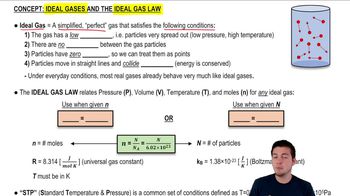
Ideal Gas Law
The Ideal Gas Law relates the pressure, volume, temperature, and number of moles of an ideal gas through the equation PV = nRT. In this scenario, the pressure and temperature changes will affect the volume of the gas above the piston, allowing us to determine the new height of the piston when the temperature is lowered.
Recommended video:
Guided course
Ideal Gases and the Ideal Gas Law
Charles's Law
Charles's Law states that the volume of a gas is directly proportional to its temperature when pressure is held constant. This principle is crucial for understanding how the height of the piston changes as the temperature decreases, as it allows us to predict that the volume will decrease with a drop in temperature.
Recommended video:
Guided course
Gauss' Law
Pressure-Volume Relationship
The pressure-volume relationship in gases indicates that for a given amount of gas at constant temperature, the product of pressure and volume remains constant (Boyle's Law). In this case, as the temperature decreases, the pressure above the piston remains constant, which influences the height of the piston and the volume of the gas.
Recommended video:
Guided course
Pressure and Atmospheric Pressure
Related Practice
Textbook Question
1
views
Textbook Question
A gas with initial state variables p1, V1, and T1 expands isothermally until V2 = 2V1. What are p2?
1
views
Textbook Question
0.10 mol of argon gas is admitted to an evacuated 50 cm3 container at 20°C. The gas then undergoes an isochoric heating to a temperature of 300°C. What is the final pressure of the gas?
3
views
Textbook Question
A gas with an initial temperature of 900°C undergoes the process shown in FIGURE EX18.35. What type of process is this?
2
views
Textbook Question
A gas with initial state variables p1, V1, and T1 is cooled in an isochoric process until p2 = (1/3)p1. What are V2?
2
views
Textbook Question
A gas with initial state variables p1, V1, and T1 expands isothermally until V2 = 2V1. What are T1?
2
views