0.10 mol of argon gas is admitted to an evacuated 50 cm3 container at 20°C. The gas then undergoes an isochoric heating to a temperature of 300°C. Show the process on a pV diagram. Include a proper scale on both axes.
Ch 18: A Macroscopic Description of Matter
Knight Calc5th EditionPhysics for Scientists and EngineersISBN: 9780137344796Not the one you use?Change textbook
Chapter 18, Problem 37a
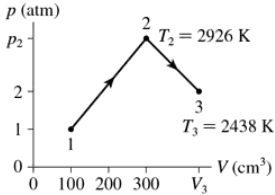
0.0050 mol of gas undergoes the process 1→2→3 shown in FIGURE EX18.37. What are temperature T1?

Verified step by step guidance1
Step 1: Identify the given values for state A from the graph. The pressure (Pₐ) is 8.00 atm, the volume (Vₐ) is 2.00 L, and the number of moles (n) is 0.0050 mol. The temperature (Tₐ) needs to be calculated.
Step 2: Recall the ideal gas law, which is expressed as: . Here, P is pressure, V is volume, n is the number of moles, R is the ideal gas constant, and T is temperature.
Step 3: Rearrange the ideal gas law to solve for temperature T: . Substitute the known values: Pₐ = 8.00 atm, Vₐ = 2.00 L, n = 0.0050 mol, and R = 0.0821 L·atm/(mol·K).
Step 4: Ensure all units are consistent. The pressure is in atm, the volume is in liters, the number of moles is in mol, and the gas constant R is in L·atm/(mol·K). No unit conversions are needed.
Step 5: Plug the values into the formula and simplify to find Tₐ. The calculation involves multiplying Pₐ and Vₐ, then dividing by the product of n and R. This will yield the temperature Tₐ in Kelvin.

Verified video answer for a similar problem:
This video solution was recommended by our tutors as helpful for the problem above.
Video duration:
4mWas this helpful?
Key Concepts
Here are the essential concepts you must grasp in order to answer the question correctly.
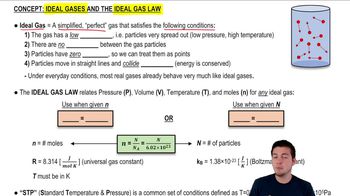
Ideal Gas Law
The Ideal Gas Law relates the pressure, volume, temperature, and number of moles of a gas through the equation PV = nRT. Here, P is pressure, V is volume, n is the number of moles, R is the ideal gas constant, and T is temperature. This law is fundamental for understanding the behavior of gases under various conditions and is essential for calculating unknown variables in gas-related problems.
Recommended video:
Guided course
Ideal Gases and the Ideal Gas Law
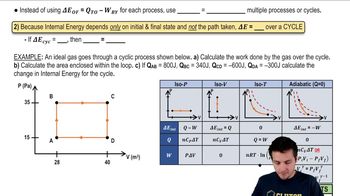
Thermodynamic Processes
Thermodynamic processes describe how a gas changes state, including isothermal (constant temperature), isobaric (constant pressure), and isochoric (constant volume) processes. Each process has distinct characteristics and equations governing the relationships between pressure, volume, and temperature. Understanding these processes is crucial for analyzing the transitions between states in the given problem.
Recommended video:
Guided course
Properties of Cyclic Thermodynamic Processes
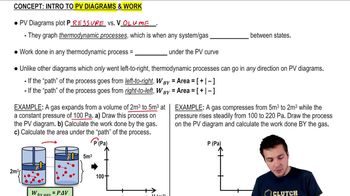
Pressure-Volume (P-V) Diagram
A Pressure-Volume (P-V) diagram visually represents the relationship between the pressure and volume of a gas during various thermodynamic processes. Points on the graph indicate specific states of the gas, while the curves represent the transitions between these states. Analyzing the P-V diagram helps in understanding how the gas behaves under different conditions, which is vital for solving the problem presented.
Recommended video:
Guided course
Work and PV Diagrams
Related Practice
Textbook Question
1
views
Textbook Question
A gas with an initial temperature of 900°C undergoes the process shown in FIGURE EX18.35. How many moles of gas are there?
2
views
Textbook Question
A gas with an initial temperature of 900°C undergoes the process shown in FIGURE EX18.35. What type of process is this?
2
views
Textbook Question
0.0050 mol of gas undergoes the process 1→2→3 shown in FIGURE EX18.37. What is the volume V3?
1
views
Textbook Question
0.0050 mol of gas undergoes the process 1→2→3 shown in FIGURE EX18.37. What are pressure p2?
2
views
Textbook Question
A sealed container holds 3.2 g of oxygen at 1 atm pressure and 20°C. The gas first undergoes an isobaric process that doubles the absolute temperature, then an isothermal process that halves the pressure. What is the final volume of the gas in L?
1
views