
Ch 16: Traveling Waves
Knight Calc - Physics for Scientists and Engineers 5th Edition
Knight Calc5th EditionPhysics for Scientists and EngineersISBN: 9780137344796Not the one you use?Change textbook
Chapter 16, Problem 68b

LASIK eye surgery uses pulses of laser light to shave off tissue from the cornea, reshaping it. A typical LASIK laser emits a 1.0-mm-diameter laser beam with a wavelength of 193 nm. Each laser pulse lasts 15 ns and contains 1.0 mJ of light energy. During the very brief time of the pulse, what is the intensity of the light wave?

Verified step by step guidance
1
Step 1: Recall the formula for intensity, which is the power per unit area: \( I = \frac{P}{A} \). Here, \( I \) is the intensity, \( P \) is the power, and \( A \) is the area over which the power is distributed.
Step 2: Calculate the power \( P \) of the laser pulse. Power is the energy delivered per unit time, so \( P = \frac{E}{t} \), where \( E \) is the energy of the pulse (1.0 mJ = 1.0 \( \times \) 10\(^{-3}\) J) and \( t \) is the duration of the pulse (15 ns = 15 \( \times \) 10\(^{-9}\) s).
Step 3: Determine the area \( A \) of the laser beam. The beam is circular with a diameter of 1.0 mm (radius = 0.5 mm = 0.5 \( \times \) 10\(^{-3}\) m). The area of a circle is given by \( A = \pi r^2 \).
Step 4: Substitute the values of \( P \) and \( A \) into the intensity formula \( I = \frac{P}{A} \) to calculate the intensity of the light wave.
Step 5: Ensure that all units are consistent (e.g., energy in joules, time in seconds, area in square meters) before performing the calculations. This will yield the intensity in units of watts per square meter (W/m\(^2\)).

Verified video answer for a similar problem:

This video solution was recommended by our tutors as helpful for the problem above.
Video duration:
5m
Was this helpful?

Key Concepts

Here are the essential concepts you must grasp in order to answer the question correctly.

Intensity of Light

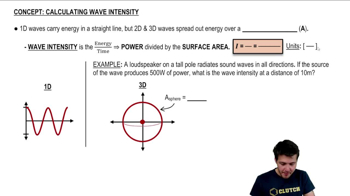
Intensity is defined as the power per unit area carried by a wave. In the context of light, it quantifies how much energy is transmitted through a specific area in a given time. The formula for intensity (I) is I = P/A, where P is the power and A is the area. Understanding intensity is crucial for analyzing how concentrated the energy from the laser beam is during the pulse.
Recommended video:
Guided course
02:32
Wave Intensity

Power of the Laser Pulse

Power is the rate at which energy is transferred or converted. For the laser pulse in LASIK surgery, the power can be calculated by dividing the energy contained in the pulse by the duration of the pulse. In this case, with 1.0 mJ of energy over 15 ns, the power can be determined, which is essential for calculating the intensity of the light wave.
Recommended video:

Area of the Laser Beam

The area over which the laser beam is focused is critical for determining intensity. The area of a circular beam can be calculated using the formula A = πr², where r is the radius of the beam. Given that the diameter of the laser beam is 1.0 mm, this area will be used in conjunction with the power to find the intensity of the light wave during the pulse.
Recommended video:
Guided course
13:40
Beam supporting an object
Related Practice
Textbook Question

A battery-powered siren emits 0.50 W of sound power at 1000 Hz. It is dropped from 100 m directly over your head on a 20°C day. 4.0 s after it is released, what are (a) the frequency and (b) the sound intensity level you hear?

1
views
Textbook Question

A physics professor demonstrates the Doppler effect by tying a 600 Hz sound generator to a 1.0-m-long rope and whirling it around her head in a horizontal circle at 100 rpm. What are the highest and lowest frequencies heard by a student in the classroom?

2
views
Textbook Question

A 1000 Hz sound wave traveling through 20°C air causes the pressure to oscillate around atmospheric pressure by ±0.050%. What is the maximum speed of an oscillating air molecule? Give your answer in mm/s.

1
views
Textbook Question

A string that is under 50.0 N of tension has linear density 5.0 g/m. A sinusoidal wave with amplitude 3.0 cm and wavelength 2.0 m travels along the string. What is the maximum speed of a particle on the string?

1
views
Textbook Question

The string in FIGURE P16.59 has linear density μ. Find an expression in terms of M, μ, and θ for the speed of waves on the string.

5
views
Textbook Question

Some modern optical devices are made with glass whose index of refraction changes with distance from the front surface. FIGURE P16.72 shows the index of refraction as a function of the distance into a slab of glass of thickness L. The index of refraction increases linearly from n1 at the front surface to n₂ at the rear surface. Evaluate your expression for a 1.0-cm-thick piece of glass for which n1 = 1.50 and n2 = 1.60.