
Ch 15: Oscillations
Knight Calc - Physics for Scientists and Engineers 5th Edition
Knight Calc5th EditionPhysics for Scientists and EngineersISBN: 9780137344796Not the one you use?Change textbook
Chapter 15, Problem 82g

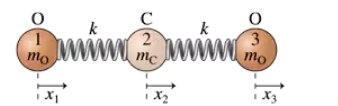
The greenhouse-gas carbon dioxide molecule CO₂ strongly absorbs infrared radiation when its vibrational normal modes are excited by light at the normal-mode frequencies. CO₂ is a linear triatomic molecule, as shown in FIGURE CP15.82, with oxygen atoms of mass mo bonded to a central carbon atom of mass mc. You know from chemistry that the atomic masses of carbon and oxygen are, respectively, 12 and 16. Assume that the bond is an ideal spring with spring constant k. There are two normal modes of this system for which oscillations take place along the axis. (You can ignore additional bending modes.) In this problem, you will find the normal modes and then use experimental data to determine the bond spring constant. The symmetric stretch frequency is known to be 4.00 X 10¹³ Hz. What is the spring constant of the C - O bond? Use 1 u = 1 atomic mass unit = 1.66 X 10⁻²⁷ kg to find the atomic masses in SI units. Interestingly, the spring constant is similar to that of springs you might use in the lab.

Verified step by step guidance
1
Step 1: Convert the atomic masses of carbon and oxygen into SI units. Use the given atomic masses (12 u for carbon and 16 u for oxygen) and the conversion factor 1 u = 1.66 × 10⁻²⁷ kg. The mass of carbon (mc) is 12 × 1.66 × 10⁻²⁷ kg, and the mass of oxygen (mo) is 16 × 1.66 × 10⁻²⁷ kg.
Step 2: Determine the reduced mass (μ) of the system. For the symmetric stretch mode, the reduced mass is given by the formula: μ=mcmo/mc+mo. Substitute the values of mc and mo from Step 1 into this formula.
Step 3: Use the formula for the angular frequency of a harmonic oscillator to relate the spring constant (k) to the symmetric stretch frequency (f). The angular frequency (ω) is related to the frequency by ω=2πf. The relationship between ω, k, and μ is given by ω=kμ. Substitute the given frequency (f = 4.00 × 10¹³ Hz) into the formula for ω.
Step 4: Rearrange the formula ω=kμ to solve for the spring constant k. The expression becomes k=μω². Substitute the values of μ (from Step 2) and ω (from Step 3) into this formula.
Step 5: Perform the necessary calculations to find the spring constant k. Ensure that all units are consistent (e.g., mass in kg, frequency in Hz) to obtain the spring constant in SI units (N/m).

Verified video answer for a similar problem:

This video solution was recommended by our tutors as helpful for the problem above.
Video duration:
9m
Was this helpful?

Key Concepts

Here are the essential concepts you must grasp in order to answer the question correctly.

Normal Modes of Vibration

Normal modes of vibration refer to the specific patterns in which molecules oscillate when they are excited. For a triatomic molecule like CO₂, there are distinct modes, including symmetric and asymmetric stretches, where atoms move in coordinated ways. Understanding these modes is crucial for analyzing how the molecule interacts with infrared radiation, as each mode has a characteristic frequency that corresponds to the energy of the absorbed light.
Recommended video:
Guided course
08:17
The Normal Force

Spring Constant

The spring constant (k) is a measure of a spring's stiffness, defined by Hooke's Law, which states that the force exerted by a spring is proportional to its displacement. In molecular terms, the bond between atoms can be modeled as a spring, where the spring constant quantifies how much force is needed to stretch or compress the bond. This concept is essential for calculating the vibrational frequencies of molecular bonds, as it directly influences the energy levels associated with molecular vibrations.
Recommended video:
Guided course
08:59
Phase Constant of a Wave Function

Atomic Mass and SI Units

Atomic mass is a measure of the mass of an atom, typically expressed in atomic mass units (u), where 1 u is approximately 1.66 x 10⁻²⁷ kg. Converting atomic masses to SI units is necessary for calculations involving physical constants, such as the spring constant. In this problem, knowing the atomic masses of carbon and oxygen allows for the determination of the effective mass in the vibrational model, which is critical for finding the spring constant from the given frequency of oscillation.
Recommended video:
Guided course
03:18
Introduction to Units & the SI System
Related Practice
Textbook Question

A spring is standing upright on a table with its bottom end fastened to the table. A block is dropped from a height 3.0 cm above the top of the spring. The block sticks to the top end of the spring and then oscillates with an amplitude of 10 cm. What is the oscillation frequency?

1
views
Textbook Question

The greenhouse-gas carbon dioxide molecule CO₂ strongly absorbs infrared radiation when its vibrational normal modes are excited by light at the normal-mode frequencies. CO₂ is a linear triatomic molecule, as shown in FIGURE CP15.82, with oxygen atoms of mass mo bonded to a central carbon atom of mass mc. You know from chemistry that the atomic masses of carbon and oxygen are, respectively, 12 and 16. Assume that the bond is an ideal spring with spring constant k. There are two normal modes of this system for which oscillations take place along the axis. (You can ignore additional bending modes.) In this problem, you will find the normal modes and then use experimental data to determine the bond spring constant. Use the frequency of the symmetric stretch to predict the frequency of the antisymmetric stretch. The measured frequency is 7.05 × 10¹³ Hz so your prediction is close but not perfect. The reason is that the bonds are not ideal springs but have a slight amount of anharmonicity. Nonetheless, you’ve learned a great deal about the CO₂ molecule from a simple model of oscillating masses.

1
views
Textbook Question

A uniform rod of length L oscillates as a pendulum about a pivot that is a distance x from the center. For what value of x, in terms of L, is the oscillation period a minimum?

1
views
Textbook Question

Suppose a large spherical object, such as a planet, with radius R and mass M has a narrow tunnel passing diametrically through it. A particle of mass m is inside the tunnel at a distance 𝓍 ≤ R from the center. It can be shown that the net gravitational force on the particle is due entirely to the sphere of mass with radius 𝓇 ≤ 𝓍 there is no net gravitational force from the mass in the spherical shell with 𝓇 > 𝓍. a. Find an expression for the gravitational force on the particle, assuming the object has uniform density. Your expression will be in terms of x, R, m, M, and any necessary constants.

1
views