

Ch 15: Oscillations
Knight Calc - Physics for Scientists and Engineers 5th Edition
Knight Calc5th EditionPhysics for Scientists and EngineersISBN: 9780137344796Not the one you use?Change textbook
Chapter 15, Problem 62

A uniform rod of mass M and length L swings as a pendulum on a pivot at distance L/4 from one end of the rod. Find an expression for the frequency f of small-angle oscillations.

Verified step by step guidance
1
Start by identifying the physical system: The rod is a physical pendulum, and its pivot is located at a distance L/4 from one end. The goal is to find the frequency of small-angle oscillations, which requires determining the moment of inertia and the torque due to gravity.
Calculate the moment of inertia of the rod about the pivot point using the parallel axis theorem. The moment of inertia about the center of mass is \( I_{\text{cm}} = \frac{1}{12} M L^2 \). Using the parallel axis theorem, the moment of inertia about the pivot is \( I = I_{\text{cm}} + M d^2 \), where \( d = \frac{L}{4} \). Substitute \( d \) and simplify.
Determine the torque due to gravity. The center of mass of the rod is located at its midpoint, which is a distance \( \frac{L}{2} \) from one end. The distance from the pivot to the center of mass is \( r = \frac{L}{2} - \frac{L}{4} = \frac{L}{4} \). The torque is \( \tau = -M g r \sin(\theta) \), where \( \theta \) is the angular displacement. For small angles, \( \sin(\theta) \approx \theta \).
Write the equation of motion for the angular displacement \( \theta \) using Newton's second law for rotation: \( I \frac{d^2 \theta}{dt^2} = \tau \). Substitute the expressions for \( I \) and \( \tau \), and simplify to obtain a differential equation of the form \( \frac{d^2 \theta}{dt^2} + \omega^2 \theta = 0 \), where \( \omega = \sqrt{\frac{M g r}{I}} \).
Relate the angular frequency \( \omega \) to the frequency \( f \) using the formula \( f = \frac{\omega}{2 \pi} \). Substitute \( \omega = \sqrt{\frac{M g r}{I}} \), where \( r = \frac{L}{4} \) and \( I \) is the moment of inertia calculated earlier. Simplify the expression to find \( f \) in terms of \( M \), \( L \), and \( g \).

Verified video answer for a similar problem:

This video solution was recommended by our tutors as helpful for the problem above.
Video duration:
12m
Was this helpful?

Key Concepts

Here are the essential concepts you must grasp in order to answer the question correctly.

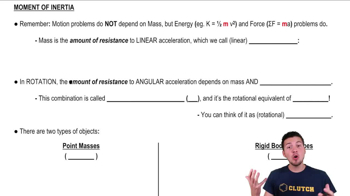
Moment of Inertia

The moment of inertia is a measure of an object's resistance to changes in its rotation about an axis. For a uniform rod, the moment of inertia depends on its mass distribution relative to the pivot point. In this case, the pivot is located at L/4 from one end, which affects the calculation of the moment of inertia for the oscillating rod.
Recommended video:
Guided course
11:47
Intro to Moment of Inertia

Simple Harmonic Motion (SHM)

Simple Harmonic Motion refers to the oscillatory motion of an object where the restoring force is directly proportional to the displacement from its equilibrium position. In the context of a pendulum, small-angle approximations allow us to treat the motion as SHM, enabling the use of formulas to determine frequency and period of oscillations.
Recommended video:
Guided course
07:52
Simple Harmonic Motion of Pendulums

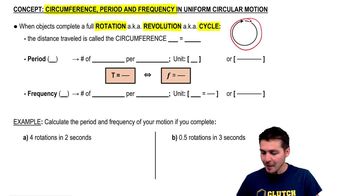
Frequency of Oscillation

The frequency of oscillation is the number of complete cycles of motion that occur in a unit of time, typically measured in hertz (Hz). For a pendulum undergoing small-angle oscillations, the frequency can be derived from the formula f = (1/2π)√(g/L_eff), where g is the acceleration due to gravity and L_eff is the effective length of the pendulum, which is influenced by the moment of inertia and the pivot point.
Recommended video:
Guided course
05:08
Circumference, Period, and Frequency in UCM
Related Practice
Textbook Question

A 500 g air-track glider attached to a spring with spring constant 10 N/m is sitting at rest on a frictionless air track. A 250 g glider is pushed toward it from the far end of the track at a speed of 120 cm/s. It collides with and sticks to the 500 g glider. What are the amplitude and period of the subsequent oscillations?

1
views
Textbook Question

It has recently become possible to 'weigh' DNA molecules by measuring the influence of their mass on a nano-oscillator. FIGURE P15.58 shows a thin rectangular cantilever etched out of silicon (density 2300 kg/m³) with a small gold dot (not visible) at the end. If pulled down and released, the end of the cantilever vibrates with SHM, moving up and down like a diving board after a jump. When bathed with DNA molecules whose ends have been modified to bind with gold, one or more molecules may attach to the gold dot. The addition of their mass causes a very slight—but measurable—decrease in the oscillation frequency. A vibrating cantilever of mass M can be modeled as a block of mass ⅓M attached to a spring. (The factor of ⅓ arises from the moment of inertia of a bar pivoted at one end.) Neither the mass nor the spring constant can be determined very accurately—perhaps to only two significant figures—but the oscillation frequency can be measured with very high precision simply by counting the oscillations. In one experiment, the cantilever was initially vibrating at exactly 12 MHz. Attachment of a DNA molecule caused the frequency to decrease by 50 Hz. What was the mass of the DNA?

1
views
Textbook Question

The 15 g head of a bobble-head doll oscillates in SHM at a frequency of 4.0 Hz. The amplitude of the head's oscillations decreases to 0.5 cm in 4.0 s. What is the head's damping constant?

Textbook Question

A 15-cm-long, 200 g rod is pivoted at one end. A 20 g ball of clay is stuck on the other end. What is the period if the rod and clay swing as a pendulum?

2
views
Textbook Question

A 1.00 kg block is attached to a horizontal spring with spring constant 2500 N/m. The block is at rest on a frictionless surface. A 10 g bullet is fired into the block, in the face opposite the spring, and sticks. What was the bullet's speed if the subsequent oscillations have an amplitude of 10.0 cm?

Textbook Question

Interestingly, there have been several studies using cadavers to determine the moments of inertia of human body parts, information that is important in biomechanics. In one study, the center of mass of a 5.0 kg lower leg was found to be 18 cm from the knee. When the leg was allowed to pivot at the knee and swing freely as a pendulum, the oscillation frequency was 1.6 Hz. What was the moment of inertia of the lower leg about the knee joint?

3
views