Ch 15: Oscillations
Knight Calc - Physics for Scientists and Engineers 5th Edition
Knight Calc5th EditionPhysics for Scientists and EngineersISBN: 9780137344796Not the one you use?Change textbook
Chapter 15, Problem 75

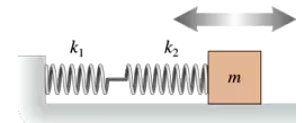
A block on a frictionless table is connected as shown in FIGURE P15.75 to two springs having spring constants k₁ and k₂. Find an expression for the block’s oscillation frequency f in terms of the frequencies f₁ and f₂ at which it would oscillate if attached to spring 1 or spring 2 alone.

Verified step by step guidance
1
Step 1: Begin by recalling the formula for the angular frequency of a spring-mass system. The angular frequency ω is given by \( \omega = \sqrt{\frac{k}{m}} \), where \( k \) is the spring constant and \( m \) is the mass of the block. The oscillation frequency \( f \) is related to \( \omega \) by \( f = \frac{\omega}{2\pi} \).
Step 2: For the block attached to spring 1 alone, the angular frequency \( \omega_1 \) is \( \omega_1 = \sqrt{\frac{k_1}{m}} \), and the frequency \( f_1 \) is \( f_1 = \frac{\omega_1}{2\pi} \). Similarly, for spring 2 alone, \( \omega_2 = \sqrt{\frac{k_2}{m}} \) and \( f_2 = \frac{\omega_2}{2\pi} \).
Step 3: When the block is connected to both springs, the effective spring constant \( k_{\text{eff}} \) is the sum of the individual spring constants because the springs are in parallel. Thus, \( k_{\text{eff}} = k_1 + k_2 \).
Step 4: Using the effective spring constant \( k_{\text{eff}} \), the angular frequency of the block's oscillation is \( \omega = \sqrt{\frac{k_{\text{eff}}}{m}} = \sqrt{\frac{k_1 + k_2}{m}} \). The oscillation frequency \( f \) is then \( f = \frac{\omega}{2\pi} = \frac{1}{2\pi} \sqrt{\frac{k_1 + k_2}{m}} \).
Step 5: Express \( k_1 \) and \( k_2 \) in terms of \( f_1 \) and \( f_2 \) using \( k_1 = (2\pi f_1)^2 m \) and \( k_2 = (2\pi f_2)^2 m \). Substitute these into the expression for \( f \) to find \( f \) in terms of \( f_1 \) and \( f_2 \): \( f = \frac{1}{2\pi} \sqrt{(2\pi f_1)^2 + (2\pi f_2)^2} \).

Verified video answer for a similar problem:

This video solution was recommended by our tutors as helpful for the problem above.
Video duration:
13m
Was this helpful?

Key Concepts

Here are the essential concepts you must grasp in order to answer the question correctly.

Simple Harmonic Motion (SHM)

Simple Harmonic Motion is a type of periodic motion where an object oscillates around an equilibrium position. The restoring force acting on the object is directly proportional to its displacement from that position and acts in the opposite direction. This motion is characterized by a constant frequency and can be described mathematically by sinusoidal functions.
Recommended video:
Guided course
07:52
Simple Harmonic Motion of Pendulums

Spring Constant (k)

The spring constant, denoted as k, is a measure of a spring's stiffness. It quantifies the amount of force required to stretch or compress the spring by a unit distance. A higher spring constant indicates a stiffer spring, which results in a higher frequency of oscillation when the spring is used in a system, as described by Hooke's Law.
Recommended video:
Guided course
08:59
Phase Constant of a Wave Function

Frequency of Oscillation

The frequency of oscillation, denoted as f, is the number of complete cycles of motion that occur in a unit of time, typically measured in hertz (Hz). For a mass-spring system, the frequency is influenced by the mass of the object and the effective spring constant. The relationship between these variables can be expressed through the formula f = (1/2π)√(k/m), where k is the spring constant and m is the mass.
Recommended video:
Guided course
05:08
Circumference, Period, and Frequency in UCM
Related Practice
Textbook Question

The 15 g head of a bobble-head doll oscillates in SHM at a frequency of 4.0 Hz. The amplitude of the head's oscillations decreases to 0.5 cm in 4.0 s. What is the head's damping constant?

Textbook Question

A spring is standing upright on a table with its bottom end fastened to the table. A block is dropped from a height 3.0 cm above the top of the spring. The block sticks to the top end of the spring and then oscillates with an amplitude of 10 cm. What is the oscillation frequency?

1
views
Textbook Question

A 15-cm-long, 200 g rod is pivoted at one end. A 20 g ball of clay is stuck on the other end. What is the period if the rod and clay swing as a pendulum?

2
views
Textbook Question

A uniform rod of length L oscillates as a pendulum about a pivot that is a distance x from the center. For what value of x, in terms of L, is the oscillation period a minimum?

1
views
Textbook Question

A 200 g oscillator in a vacuum chamber has a frequency of 2.0 Hz. When air is admitted, the oscillation decreases to 60% of its initial amplitude in 50 s. How many oscillations will have been completed when the amplitude is 30% of its initial value?

Textbook Question

Suppose a large spherical object, such as a planet, with radius R and mass M has a narrow tunnel passing diametrically through it. A particle of mass m is inside the tunnel at a distance 𝓍 ≤ R from the center. It can be shown that the net gravitational force on the particle is due entirely to the sphere of mass with radius 𝓇 ≤ 𝓍 there is no net gravitational force from the mass in the spherical shell with 𝓇 > 𝓍. a. Find an expression for the gravitational force on the particle, assuming the object has uniform density. Your expression will be in terms of x, R, m, M, and any necessary constants.

1
views