Ch 15: Oscillations
Knight Calc - Physics for Scientists and Engineers 5th Edition
Knight Calc5th EditionPhysics for Scientists and EngineersISBN: 9780137344796Not the one you use?Change textbook
Chapter 15, Problem 19b

A 500 g air-track glider moving at 0.50 m/s collides with a horizontal spring whose opposite end is anchored to the end of the track. Measurements show that the glider is in contact with the spring for 1.5 s before it rebounds. What is the maximum compression of the spring?

Verified step by step guidance
1
Convert the mass of the glider from grams to kilograms: \( m = 500 \ \text{g} = 0.500 \ \text{kg} \). This ensures consistency in SI units for calculations.
Determine the initial kinetic energy of the glider using the formula for kinetic energy: \( KE = \frac{1}{2} m v^2 \), where \( v = 0.50 \ \text{m/s} \) is the initial velocity of the glider.
Recognize that the glider's kinetic energy is fully converted into the elastic potential energy of the spring at maximum compression. The elastic potential energy is given by \( PE = \frac{1}{2} k x^2 \), where \( k \) is the spring constant and \( x \) is the maximum compression of the spring.
Use the relationship \( KE = PE \) to equate \( \frac{1}{2} m v^2 = \frac{1}{2} k x^2 \). Simplify this equation to solve for \( x \): \( x = \sqrt{\frac{m v^2}{k}} \).
To find the maximum compression \( x \), you need the value of the spring constant \( k \). If \( k \) is not provided, it must be determined from additional information (e.g., force or displacement data). Once \( k \) is known, substitute the values of \( m \), \( v \), and \( k \) into the equation for \( x \) to calculate the maximum compression.

Verified video answer for a similar problem:

This video solution was recommended by our tutors as helpful for the problem above.
Video duration:
3m
Was this helpful?

Key Concepts

Here are the essential concepts you must grasp in order to answer the question correctly.

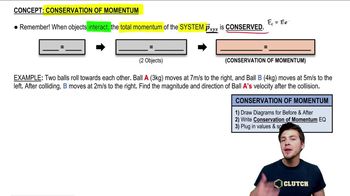
Conservation of Momentum

The principle of conservation of momentum states that in a closed system, the total momentum before an event must equal the total momentum after the event, provided no external forces act on it. In this scenario, the glider's momentum before colliding with the spring will be transferred to the spring during compression, allowing us to analyze the interaction and determine the maximum compression.
Recommended video:
Guided course
05:58
Conservation Of Momentum

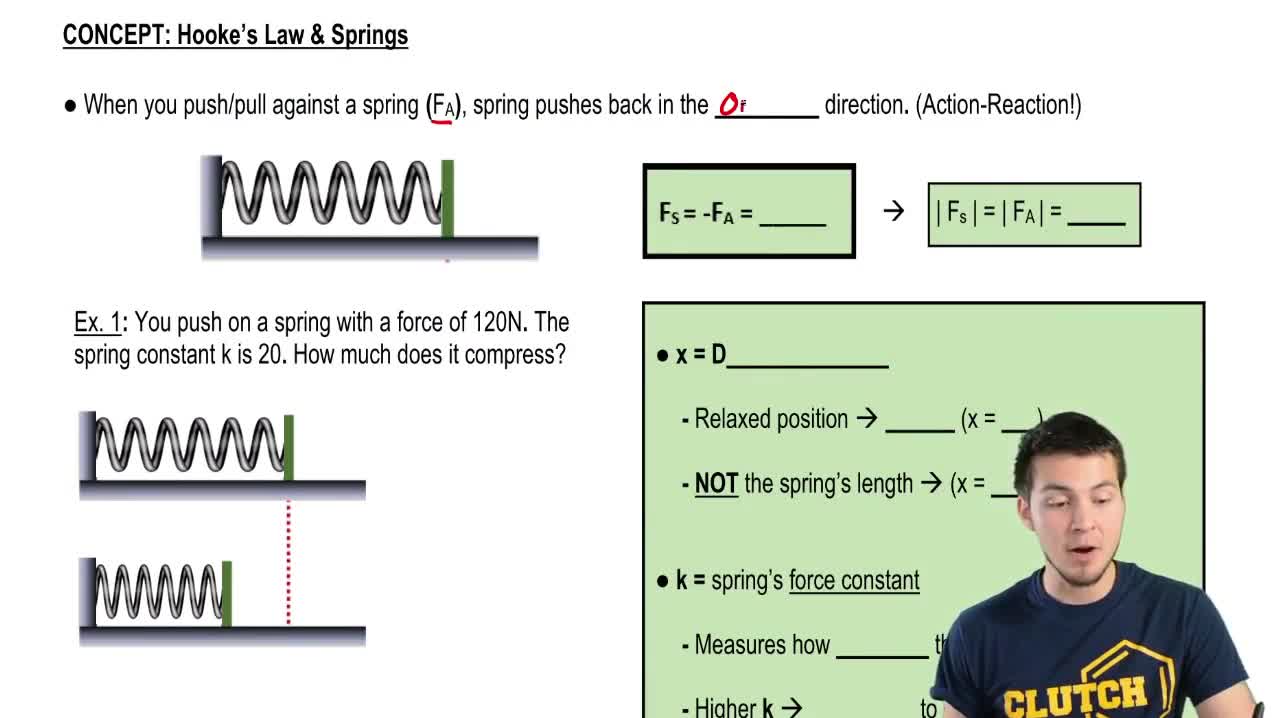
Hooke's Law

Hooke's Law describes the relationship between the force exerted on a spring and the displacement of the spring from its equilibrium position. It states that the force exerted by a spring is directly proportional to the amount it is compressed or stretched, expressed mathematically as F = -kx, where k is the spring constant and x is the displacement. This law is essential for calculating the maximum compression of the spring in the given problem.
Recommended video:
Guided course
05:27
Spring Force (Hooke's Law)

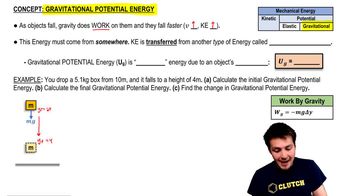
Kinetic and Potential Energy

Kinetic energy is the energy of an object due to its motion, calculated as KE = 0.5mv², where m is mass and v is velocity. Potential energy in a spring, on the other hand, is stored energy when the spring is compressed or stretched, given by PE = 0.5kx². Understanding the conversion between kinetic energy of the glider and potential energy of the spring during the collision is crucial for determining the maximum compression of the spring.
Recommended video:
Guided course
06:35
Gravitational Potential Energy