Ch 15: Oscillations
Knight Calc - Physics for Scientists and Engineers 5th Edition
Knight Calc5th EditionPhysics for Scientists and EngineersISBN: 9780137344796Not the one you use?Change textbook
Chapter 15, Problem 14

A 200 g air-track glider is attached to a spring. The glider is pushed in 10 cm and released. A student with a stopwatch finds that 10 oscillations take 12.0 s. What is the spring constant?

Verified step by step guidance
1
Convert the mass of the glider from grams to kilograms. Since 1 g = 0.001 kg, the mass \( m \) is \( 200 \times 0.001 = 0.2 \, \text{kg} \).
Determine the period of one oscillation. The period \( T \) is the time for one complete oscillation, which can be calculated by dividing the total time for 10 oscillations by 10: \( T = \frac{12.0}{10} \, \text{s} \).
Use the formula for the period of a mass-spring system: \( T = 2\pi \sqrt{\frac{m}{k}} \), where \( T \) is the period, \( m \) is the mass, and \( k \) is the spring constant. Rearrange this formula to solve for \( k \): \( k = \frac{4\pi^2 m}{T^2} \).
Substitute the known values into the formula: \( m = 0.2 \, \text{kg} \) and \( T \) (calculated in step 2). Ensure that \( T \) is squared in the denominator.
Simplify the expression to find the spring constant \( k \). The units of \( k \) will be in \( \text{N/m} \), as it represents the stiffness of the spring.

Verified video answer for a similar problem:

This video solution was recommended by our tutors as helpful for the problem above.
Video duration:
3m
Was this helpful?

Key Concepts

Here are the essential concepts you must grasp in order to answer the question correctly.

Hooke's Law

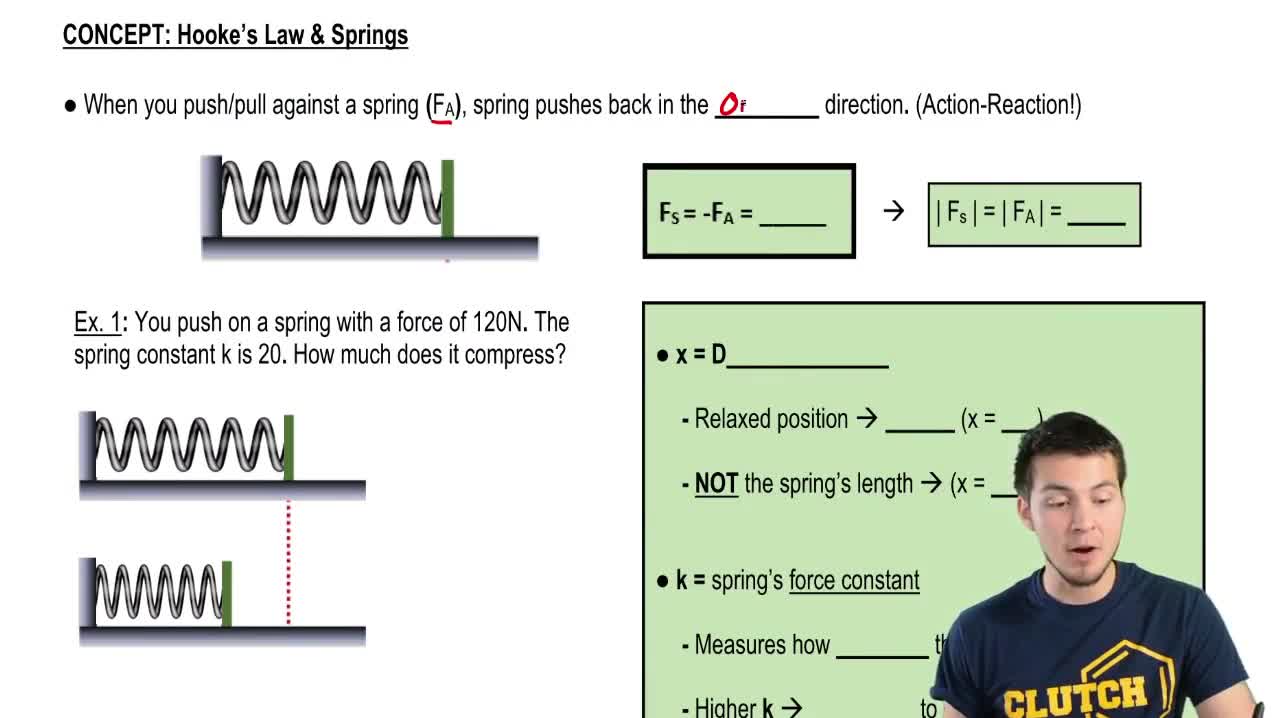
Hooke's Law states that the force exerted by a spring is directly proportional to the displacement from its equilibrium position, expressed as F = -kx, where F is the force, k is the spring constant, and x is the displacement. This principle is fundamental in understanding how springs behave when compressed or stretched.
Recommended video:
Guided course
05:27
Spring Force (Hooke's Law)

Simple Harmonic Motion (SHM)

Simple Harmonic Motion is a type of periodic motion where an object oscillates around an equilibrium position. In the case of a mass-spring system, the motion is characterized by a restoring force proportional to the displacement, leading to a sinusoidal motion. The period of oscillation depends on the mass and the spring constant.
Recommended video:
Guided course
07:52
Simple Harmonic Motion of Pendulums

Period of Oscillation

The period of oscillation is the time taken for one complete cycle of motion in a harmonic system. For a mass-spring system, the period T can be calculated using the formula T = 2π√(m/k), where m is the mass attached to the spring and k is the spring constant. This relationship is crucial for determining the spring constant from the observed oscillation time.
Recommended video:
Guided course
06:28
Satellite Period