
Ch 12: Rotation of a Rigid Body
Knight Calc - Physics for Scientists and Engineers 5th Edition
Knight Calc5th EditionPhysics for Scientists and EngineersISBN: 9780137344796Not the one you use?Change textbook
Chapter 12, Problem 83a

During most of its lifetime, a star maintains an equilibrium size in which the inward force of gravity on each atom is balanced by an outward pressure force due to the heat of the nuclear reactions in the core. But after all the hydrogen 'fuel' is consumed by nuclear fusion, the pressure force drops and the star undergoes a gravitational collapse until it becomes a neutron star. In a neutron star, the electrons and protons of the atoms are squeezed together by gravity until they fuse into neutrons. Neutron stars spin very rapidly and emit intense pulses of radio and light waves, one pulse per rotation. These 'pulsing stars' were discovered in the 1960s and are called pulsars. a. A star with the mass (M = 2.0 X 1030 kg) and size (R = 7.0 x 10⁸ m) of our sun rotates once every 30 days. After undergoing gravitational collapse, the star forms a pulsar that is observed by astronomers to emit radio pulses every 0.10 s. By treating the neutron star as a solid sphere, deduce its radius.

Verified step by step guidance
1
Step 1: Understand the conservation of angular momentum. The angular momentum of the star before and after the collapse remains constant because there are no external torques acting on the system. The formula for angular momentum is L = Iω, where I is the moment of inertia and ω is the angular velocity.
Step 2: Write the moment of inertia for a solid sphere. The moment of inertia of a solid sphere is given by I = (2/5)MR², where M is the mass and R is the radius of the sphere. Use this formula for both the initial star and the neutron star.
Step 3: Calculate the initial angular velocity (ω_initial) of the star. Angular velocity is related to the rotation period (T) by the formula ω = 2π/T. For the initial star, T = 30 days, which needs to be converted into seconds.
Step 4: Calculate the final angular velocity (ω_final) of the neutron star. The rotation period of the neutron star is given as 0.10 s, so use the same formula ω = 2π/T to find ω_final.
Step 5: Apply the conservation of angular momentum. Set the initial angular momentum equal to the final angular momentum: (2/5)M(R_initial²)(ω_initial) = (2/5)M(R_final²)(ω_final). Simplify the equation to solve for R_final, the radius of the neutron star.

Verified video answer for a similar problem:

This video solution was recommended by our tutors as helpful for the problem above.
Video duration:
9m
Was this helpful?

Key Concepts

Here are the essential concepts you must grasp in order to answer the question correctly.

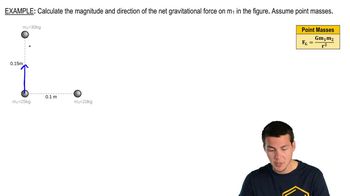
Gravitational Equilibrium

Gravitational equilibrium in a star occurs when the inward gravitational force pulling matter toward the center is balanced by the outward pressure from nuclear fusion reactions in the core. This balance allows the star to maintain a stable size and prevents it from collapsing under its own gravity. When the nuclear fuel is depleted, this equilibrium is disrupted, leading to gravitational collapse.
Recommended video:
Guided course
05:41
Gravitational Forces in 2D

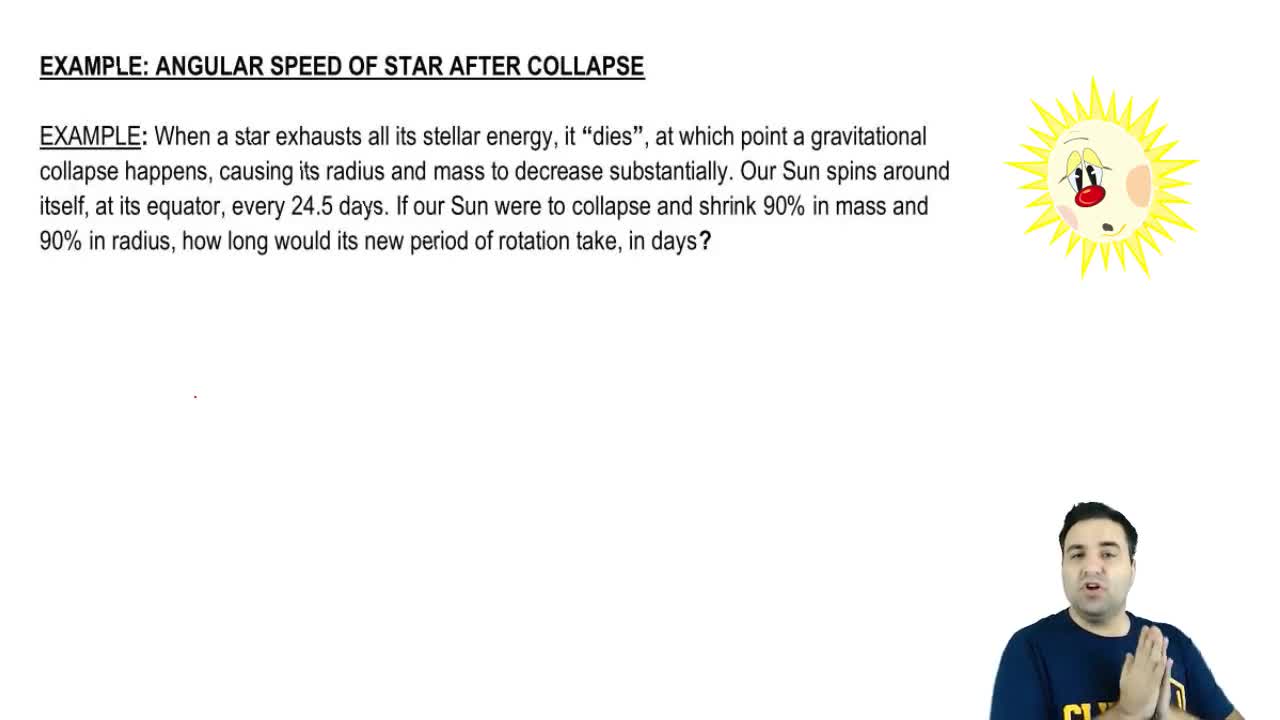
Neutron Star Formation

A neutron star forms when a massive star exhausts its nuclear fuel and undergoes gravitational collapse, compressing electrons and protons to form neutrons. This process results in an extremely dense object, where the gravitational forces are so strong that normal atomic structures cannot exist. Neutron stars are typically about 1.4 times the mass of the sun but compressed into a radius of only about 10 kilometers.
Recommended video:
Guided course
06:36
Star collapses

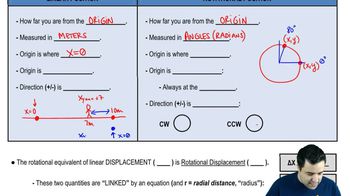
Pulsars and Rotation

Pulsars are a type of neutron star that emit beams of electromagnetic radiation, including radio waves, due to their rapid rotation and strong magnetic fields. As the neutron star spins, these beams sweep across space, and if aligned with Earth, they can be detected as regular pulses. The rotation period of a pulsar can be extremely short, often just milliseconds, which is a result of the conservation of angular momentum during the collapse of the star.
Recommended video:
Guided course
14:03
Rotational Position & Displacement
Related Practice
Textbook Question

The two blocks in FIGURE CP12.86 are connected by a massless rope that passes over a pulley. The pulley is 12 cm in diameter and has a mass of 2.0 kg. As the pulley turns, friction at the axle exerts a torque of magnitude 0.50 N m. If the blocks are released from rest, how long does it take the 4.0 kg block to reach the floor?

Textbook Question

A 10 g bullet traveling at 400 m/s strikes a 10 kg, 1.0-m-wide door at the edge opposite the hinge. The bullet embeds itself in the door, causing the door to swing open. What is the angular velocity of the door just after impact?

1
views
Textbook Question

A rod of length L and mass M has a nonuniform mass distribution. The linear mass density (mass per length) is λ = cx2, where x is measured from the center of the rod and c is a constant. Find an expression for c in terms of L and M.

2
views
Textbook Question

A merry-go-round is a common piece of playground equipment. A 3.0-m-diameter merry-go-round with a mass of 250 kg is spinning at 20 rpm. John runs tangent to the merry-go-round at 5.0 m/s, in the same direction that it is turning, and jumps onto the outer edge. John's mass is 30 kg. What is the merry-go-round's angular velocity, in rpm, after John jumps on?

2
views
Textbook Question

FIGURE P12.82 shows a cube of mass m sliding without friction at speed v0. It undergoes a perfectly elastic collision with the bottom tip of a rod of length d and mass M = 2m. The rod is pivoted about a frictionless axle through its center, and initially it hangs straight down and is at rest. What is the cube's velocity—both speed and direction—after the collision?

1
views
Textbook Question

Objects that rotate in air or water experience a torque due to drag. With quadratic drag, a drag torque that's negligible at low rpm quickly becomes significant as the rpm increases. Consider a square bar with cross section a x a and length L. It is rotating on an axle through its center at angular velocity ω in a fluid of density ρ. Assume that the drag coefficient C𝒹 is constant along the length of the bar. Find an expression for the magnitude of the drag torque on the bar. Hint: Begin by considering the drag force on a small piece of the bar of length dr at distance r from the axle.

2
views