Ch 12: Rotation of a Rigid Body
Knight Calc - Physics for Scientists and Engineers 5th Edition
Knight Calc5th EditionPhysics for Scientists and EngineersISBN: 9780137344796Not the one you use?Change textbook
Chapter 12, Problem 1a

A high-speed drill reaches 2000 rpm in 0.50 s. What is the magnitude of the drill's angular acceleration?

Verified step by step guidance
1
Step 1: Identify the given values in the problem. The drill's final angular velocity is given as 2000 rpm (revolutions per minute), and the time taken to reach this speed is 0.50 s. Convert the angular velocity to radians per second using the formula: \( \omega = \text{rpm} \times \frac{2\pi}{60} \).
Step 2: Recognize that the drill starts from rest, so the initial angular velocity \( \omega_0 \) is 0 rad/s. The angular acceleration \( \alpha \) can be calculated using the kinematic equation for rotational motion: \( \alpha = \frac{\omega - \omega_0}{t} \), where \( \omega \) is the final angular velocity, \( \omega_0 \) is the initial angular velocity, and \( t \) is the time.
Step 3: Substitute the converted value of \( \omega \) (in rad/s), \( \omega_0 = 0 \), and \( t = 0.50 \) s into the formula \( \alpha = \frac{\omega - \omega_0}{t} \).
Step 4: Simplify the expression to calculate the angular acceleration \( \alpha \). Ensure the units are consistent (radians per second squared).
Step 5: Interpret the result. The magnitude of the angular acceleration represents how quickly the drill's angular velocity increases over time.

Verified video answer for a similar problem:

This video solution was recommended by our tutors as helpful for the problem above.
Video duration:
4m
Was this helpful?

Key Concepts

Here are the essential concepts you must grasp in order to answer the question correctly.

Angular Velocity

Angular velocity is a measure of how quickly an object rotates around an axis, typically expressed in radians per second or revolutions per minute (rpm). In this question, the final angular velocity of the drill is given as 2000 rpm, which needs to be converted to radians per second for calculations involving angular acceleration.
Recommended video:
Guided course
06:18
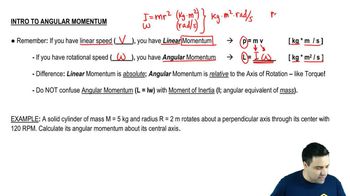
Intro to Angular Momentum

Angular Acceleration

Angular acceleration refers to the rate of change of angular velocity over time. It is calculated by taking the difference between the final and initial angular velocities and dividing by the time taken for that change. In this case, the drill's angular acceleration can be determined by using the final angular velocity and the time interval of 0.50 seconds.
Recommended video:
Guided course
12:12
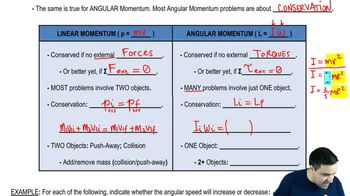
Conservation of Angular Momentum

Kinematic Equations for Rotational Motion

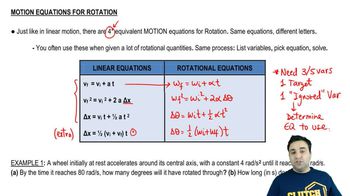
Kinematic equations for rotational motion are analogous to linear motion equations and relate angular displacement, angular velocity, angular acceleration, and time. These equations allow us to solve for unknown variables in rotational dynamics problems, such as finding angular acceleration when the final angular velocity and time are known.
Recommended video:
Guided course
07:18
Equations of Rotational Motion