
Ch 11: Impulse and Momentum
Knight Calc - Physics for Scientists and Engineers 5th Edition
Knight Calc5th EditionPhysics for Scientists and EngineersISBN: 9780137344796Not the one you use?Change textbook
Chapter 11, Problem 54

Two 500 g blocks of wood are 2.0 m apart on a frictionless table. A 10 g bullet is fired at 400 m/s toward the blocks. It passes all the way through the first block, then embeds itself in the second block. The speed of the first block immediately afterward is 6.0 m/s . What is the speed of the second block after the bullet stops in it?

Verified step by step guidance
1
Step 1: Identify the principle of conservation of momentum. Since the table is frictionless, the total momentum of the system (bullet + blocks) is conserved before and after the interactions.
Step 2: Write the equation for the conservation of momentum for the first interaction (bullet passing through the first block). Let the initial momentum of the system be \( p_{initial} = m_{bullet} v_{bullet} \), where \( m_{bullet} = 0.01 \; \text{kg} \) and \( v_{bullet} = 400 \; \text{m/s} \). After the interaction, the momentum is \( p_{final} = m_{block1} v_{block1} + m_{bullet} v_{bullet, after} \), where \( m_{block1} = 0.5 \; \text{kg} \) and \( v_{block1} = 6.0 \; \text{m/s} \). Solve for \( v_{bullet, after} \), the velocity of the bullet after passing through the first block.
Step 3: Write the conservation of momentum equation for the second interaction (bullet embedding in the second block). The initial momentum of the system is \( p_{initial} = m_{bullet} v_{bullet, after} + m_{block2} v_{block2, initial} \), where \( m_{block2} = 0.5 \; \text{kg} \) and \( v_{block2, initial} = 0 \; \text{m/s} \). After the interaction, the momentum is \( p_{final} = (m_{bullet} + m_{block2}) v_{block2, final} \). Solve for \( v_{block2, final} \), the final velocity of the second block.
Step 4: Substitute the value of \( v_{bullet, after} \) from Step 2 into the equation from Step 3. This will allow you to calculate \( v_{block2, final} \), the speed of the second block after the bullet embeds itself.
Step 5: Verify the units and ensure that the final velocity of the second block is consistent with the principle of conservation of momentum. Double-check the calculations to confirm the result.

Verified video answer for a similar problem:

This video solution was recommended by our tutors as helpful for the problem above.
Video duration:
11m
Was this helpful?

Key Concepts

Here are the essential concepts you must grasp in order to answer the question correctly.

Conservation of Momentum

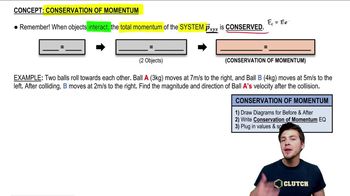
The principle of conservation of momentum states that in a closed system, the total momentum before an event must equal the total momentum after the event, provided no external forces act on it. In this scenario, the momentum of the bullet and the blocks must be calculated before and after the bullet passes through the first block and embeds in the second block.
Recommended video:
Guided course
05:58
Conservation Of Momentum

Elastic and Inelastic Collisions

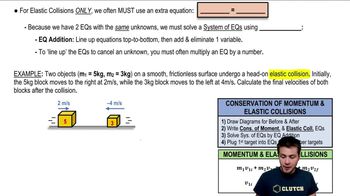
Collisions can be classified as elastic or inelastic based on whether kinetic energy is conserved. In this case, the bullet passing through the first block is an inelastic collision, as some kinetic energy is lost, while the bullet embedding in the second block is also inelastic, where the two objects move together post-collision, allowing for momentum transfer but not energy conservation.
Recommended video:
Guided course
08:56
Intro To Elastic Collisions

Kinetic Energy

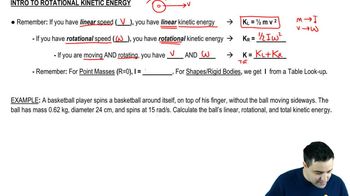
Kinetic energy is the energy possessed by an object due to its motion, calculated using the formula KE = 1/2 mv², where m is mass and v is velocity. While kinetic energy is not conserved in inelastic collisions, it is important to understand how it changes during the interactions, particularly in determining the final velocities of the blocks after the bullet embeds itself.
Recommended video:
Guided course
06:07
Intro to Rotational Kinetic Energy
Related Practice
Textbook Question

An object at rest on a flat, horizontal surface explodes into two fragments, one seven times as massive as the other. The heavier fragment slides 8.2 m before stopping. How far does the lighter fragment slide? Assume that both fragments have the same coefficient of kinetic friction.

1
views
Textbook Question

A 500 g particle has velocity vx = −5.0 m/s at t = −2 s. Force Fx = (4−t2) N, where t is in s, is exerted on the particle between t = −2 s and t = 2 s. This force increases from 0 N at t = −2 s to 4 N at t = 0 s and then back to 0 N at t = 2 s. What is the particle's velocity at t = 2s?

1
views
Textbook Question

The stoplight had just changed and a 2000 kg Cadillac had entered the intersection, heading north at 3.0 m/s , when it was struck by a 1000 kg eastbound Volkswagen. The cars stuck together and slid to a halt, leaving skid marks angled 35° north of east. How fast was the Volkswagen going just before the impact?

1
views
Textbook Question

A 1500 kg weather rocket accelerates upward at 10 m/s². It explodes 2.0 s after liftoff and breaks into two fragments, one twice as massive as the other. Photos reveal that the lighter fragment traveled straight up and reached a maximum height of 530 m. What were the speed and direction of the heavier fragment just after the explosion?

4
views
Textbook Question

What is the speed of a 10g bullet that, when fired into a 10kg stationary wood block, causes the block to slide 5.0 cm across a wood table?

Textbook Question

A 30 ton rail car and a 90 ton rail car, initially at rest, are connected together with a giant but massless compressed spring between them. When released, the 30 ton car is pushed away at a speed of 4.0 m/s relative to the 90 ton car. What is the speed of the 30 ton car relative to the ground?

1
views