
An object at rest on a flat, horizontal surface explodes into two fragments, one seven times as massive as the other. The heavier fragment slides 8.2 m before stopping. How far does the lighter fragment slide? Assume that both fragments have the same coefficient of kinetic friction.
A bullet of mass m is fired into a block of mass M that is at rest. The block, with the bullet embedded, slides distance d across a horizontal surface. The coefficient of kinetic friction is μk .Find an expression for the bullet's speed vbullet.
Verified step by step guidance
Verified video answer for a similar problem:
Key Concepts
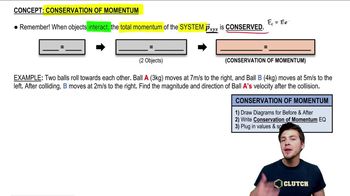
Conservation of Momentum
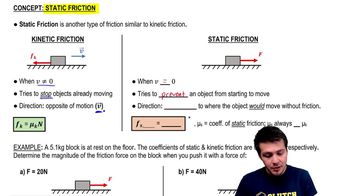
Frictional Force
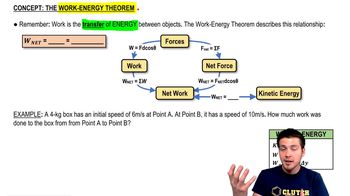
Work-Energy Principle
A 1500 kg weather rocket accelerates upward at 10 m/s². It explodes 2.0 s after liftoff and breaks into two fragments, one twice as massive as the other. Photos reveal that the lighter fragment traveled straight up and reached a maximum height of 530 m. What were the speed and direction of the heavier fragment just after the explosion?
What is the speed of a 10g bullet that, when fired into a 10kg stationary wood block, causes the block to slide 5.0 cm across a wood table?
Most geologists believe that the dinosaurs became extinct 65 million years ago when a large comet or asteroid struck the earth, throwing up so much dust that the sun was blocked out for a period of many months. Suppose an asteroid with a diameter of 2.0 km and a mass of 1.0×10¹³ kg hits the earth (6.0×10²⁴ kg) with an impact speed of 4.0×10⁴ m/s. What percentage is this of the earth's speed around the sun? The earth orbits the sun at a distance of 1.5×10¹¹ m .
A particle of mass m is at rest at t = 0. Its momentum for t > 0 is given by px = 6t² kg m/s, where t is in s. Find an expression for Fx(t), the force exerted on the particle as a function of time.
BIO Squids rely on jet propulsion to move around. A 1.50 kg squid (including the mass of water inside the squid) drifting at 0.40m/s suddenly ejects 0.100 kg of water to get itself moving at 2.50m/s . If drag is ignored over the small interval of time needed to expel the water (the impulse approximation), what is the water’s ejection speed relative to the squid?
