
Ch 10: Interactions and Potential Energy
Knight Calc - Physics for Scientists and Engineers 5th Edition
Knight Calc5th EditionPhysics for Scientists and EngineersISBN: 9780137344796Not the one you use?Change textbook
Chapter 10, Problem 73a

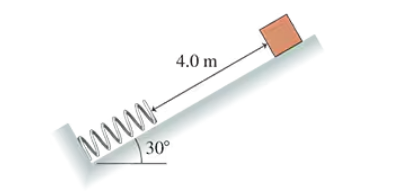
A 10 kg box slides 4.0 m down the frictionless ramp shown in FIGURE CP10.73, then collides with a spring whose spring constant is 250 N/m. What is the maximum compression of the spring?

Verified step by step guidance
1
Identify the energy transformations in the system: The box starts with gravitational potential energy at the top of the ramp, which is converted into kinetic energy as it slides down. When the box compresses the spring, the kinetic energy is converted into elastic potential energy stored in the spring.
Write the expression for gravitational potential energy at the top of the ramp: \( U_g = m g h \), where \( m = 10 \; \text{kg} \), \( g = 9.8 \; \text{m/s}^2 \), and \( h \) is the vertical height of the ramp. Use trigonometry to find \( h \) from the ramp length (4.0 m) and the angle of the ramp (from the figure, if given).
Write the expression for the elastic potential energy stored in the spring at maximum compression: \( U_s = \frac{1}{2} k x^2 \), where \( k = 250 \; \text{N/m} \) is the spring constant and \( x \) is the maximum compression of the spring.
Apply the conservation of mechanical energy: The total mechanical energy at the top of the ramp (gravitational potential energy) is equal to the total mechanical energy when the spring is maximally compressed (elastic potential energy). Set \( m g h = \frac{1}{2} k x^2 \).
Solve for \( x \), the maximum compression of the spring: Rearrange the equation to isolate \( x \): \( x = \sqrt{\frac{2 m g h}{k}} \). Substitute the known values for \( m \), \( g \), \( h \), and \( k \) to calculate \( x \).

Verified video answer for a similar problem:

This video solution was recommended by our tutors as helpful for the problem above.
Video duration:
6m
Was this helpful?

Key Concepts

Here are the essential concepts you must grasp in order to answer the question correctly.

Conservation of Energy

The principle of conservation of energy states that energy cannot be created or destroyed, only transformed from one form to another. In this scenario, the gravitational potential energy of the box at the top of the ramp is converted into kinetic energy as it slides down, and then into elastic potential energy when it compresses the spring. This relationship allows us to equate the initial potential energy to the energy stored in the spring at maximum compression.
Recommended video:
Guided course
06:24
Conservation Of Mechanical Energy

Gravitational Potential Energy

Gravitational potential energy (PE) is the energy an object possesses due to its position in a gravitational field, calculated as PE = mgh, where m is mass, g is the acceleration due to gravity, and h is the height above a reference point. In this problem, the height from which the box slides down the ramp determines the initial potential energy that will be converted into other forms of energy during the motion.
Recommended video:
Guided course
06:35
Gravitational Potential Energy

Spring Constant and Hooke's Law

The spring constant (k) is a measure of a spring's stiffness, defined by Hooke's Law, which states that the force exerted by a spring is proportional to its displacement from the equilibrium position (F = -kx). In this case, the spring constant of 250 N/m indicates how much force is needed to compress the spring by a certain distance. The maximum compression of the spring can be determined by equating the kinetic energy of the box at the point of collision to the elastic potential energy stored in the spring.
Recommended video:
Guided course
05:27
Spring Force (Hooke's Law)