Ch 05: Force and Motion
Knight Calc - Physics for Scientists and Engineers 5th Edition
Knight Calc5th EditionPhysics for Scientists and EngineersISBN: 9780137344796Not the one you use?Change textbook
Chapter 5, Problem 1

A chandelier hangs from a chain in the middle of a dining room. Identify the forces on the chandelier.

Verified step by step guidance
1
Step 1: Begin by identifying the object in question, which is the chandelier. The chandelier is stationary, meaning it is in equilibrium, and the forces acting on it must balance each other.
Step 2: Recognize the force due to gravity acting on the chandelier. This force is called the weight of the chandelier and is directed downward. It can be expressed mathematically as Fg=mg, where m is the mass of the chandelier and g is the acceleration due to gravity.
Step 3: Identify the tension force in the chain. The chain exerts an upward force on the chandelier to counteract the downward gravitational force. This tension force can be labeled as Ft.
Step 4: Apply Newton's First Law of Motion, which states that an object at rest remains at rest if the net force acting on it is zero. Since the chandelier is stationary, the upward tension force must exactly balance the downward gravitational force. Mathematically, this can be expressed as Ft=Fg.
Step 5: Conclude that the forces acting on the chandelier are the downward gravitational force and the upward tension force in the chain. These forces are equal in magnitude and opposite in direction, ensuring the chandelier remains in equilibrium.

Verified video answer for a similar problem:

This video solution was recommended by our tutors as helpful for the problem above.
Video duration:
1m
Was this helpful?

Key Concepts

Here are the essential concepts you must grasp in order to answer the question correctly.

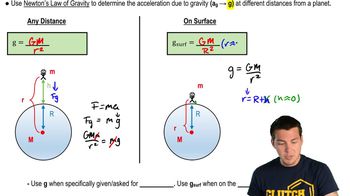
Gravity

Gravity is a fundamental force that attracts objects with mass towards one another. In the context of the chandelier, the force of gravity acts downward, pulling the chandelier towards the Earth. This force is proportional to the mass of the chandelier and is calculated using the equation F = mg, where F is the force, m is the mass, and g is the acceleration due to gravity.
Recommended video:
Guided course
05:20
Acceleration Due to Gravity

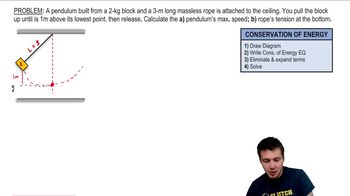
Tension

Tension is the force transmitted through a string, rope, or chain when it is pulled tight by forces acting from opposite ends. In the case of the chandelier, the chain exerts an upward tension force that counteracts the downward force of gravity. The tension in the chain must be equal to the weight of the chandelier for it to remain in equilibrium.
Recommended video:
Guided course
06:34
Calculating Tension in a Pendulum with Energy Conservation

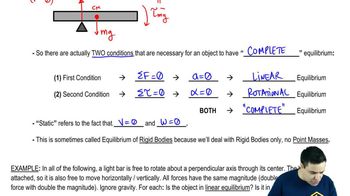
Equilibrium

Equilibrium refers to a state where the net force acting on an object is zero, resulting in no acceleration. For the chandelier to be in equilibrium, the upward tension force from the chain must balance the downward gravitational force. This balance ensures that the chandelier remains stationary and does not move up or down.
Recommended video:
Guided course
10:13
Torque & Equilibrium