Ch 03: Vectors and Coordinate Systems
Knight Calc - Physics for Scientists and Engineers 5th Edition
Knight Calc5th EditionPhysics for Scientists and EngineersISBN: 9780137344796Not the one you use?Change textbook
Chapter 3, Problem 17a

Let E = 2i + 3j and F = 2i - 2j. Find the magnitude of E and F.

Verified step by step guidance
1
Step 1: Recall the formula for the magnitude of a vector. For a vector \( \mathbf{A} = a_i \mathbf{i} + a_j \mathbf{j} \), the magnitude \( |\mathbf{A}| \) is given by \( |\mathbf{A}| = \sqrt{a_i^2 + a_j^2} \).
Step 2: For the vector \( \mathbf{E} = 2\mathbf{i} + 3\mathbf{j} \), identify the components: \( a_i = 2 \) and \( a_j = 3 \). Substitute these values into the magnitude formula: \( |\mathbf{E}| = \sqrt{2^2 + 3^2} \).
Step 3: Simplify the expression for \( |\mathbf{E}| \): \( |\mathbf{E}| = \sqrt{4 + 9} \).
Step 4: For the vector \( \mathbf{F} = 2\mathbf{i} - 2\mathbf{j} \), identify the components: \( a_i = 2 \) and \( a_j = -2 \). Substitute these values into the magnitude formula: \( |\mathbf{F}| = \sqrt{2^2 + (-2)^2} \).
Step 5: Simplify the expression for \( |\mathbf{F}| \): \( |\mathbf{F}| = \sqrt{4 + 4} \).

Verified video answer for a similar problem:

This video solution was recommended by our tutors as helpful for the problem above.
Video duration:
2m
Was this helpful?

Key Concepts

Here are the essential concepts you must grasp in order to answer the question correctly.

Vector Magnitude

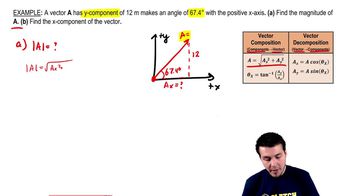
The magnitude of a vector is a measure of its length or size, calculated using the Pythagorean theorem. For a vector represented as E = ai + bj, the magnitude is given by |E| = √(a² + b²). This concept is essential for determining how 'strong' or 'large' a vector is in a given space.
Recommended video:
Guided course
03:59
Calculating Magnitude & Components of a Vector

Vector Components

Vectors can be broken down into components along the coordinate axes, typically represented as i (horizontal) and j (vertical) in two-dimensional space. For example, the vector E = 2i + 3j has a component of 2 along the x-axis and 3 along the y-axis. Understanding these components is crucial for calculating the magnitude and direction of vectors.
Recommended video:
Guided course
07:30
Vector Addition By Components

Vector Addition

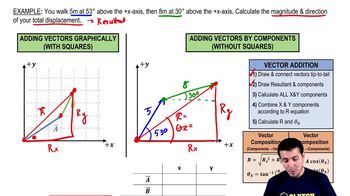
Vector addition involves combining two or more vectors to form a resultant vector. This is done by adding their corresponding components. For instance, if E and F are added, the resultant vector R = E + F is found by summing the i components and the j components separately. This concept is fundamental in physics for analyzing forces and motion.
Recommended video:
Guided course
07:30
Vector Addition By Components