Ch 03: Vectors and Coordinate Systems
Knight Calc - Physics for Scientists and Engineers 5th Edition
Knight Calc5th EditionPhysics for Scientists and EngineersISBN: 9780137344796Not the one you use?Change textbook
Chapter 3, Problem 14c

Let A = 4i - 2j, B = -3i + 5j, and E = 2A + 3B. What are the magnitude and direction of vector E?

Verified step by step guidance
1
Start by calculating the vector E using the given formula: \( \mathbf{E} = 2\mathbf{A} + 3\mathbf{B} \). Substitute \( \mathbf{A} = 4\mathbf{i} - 2\mathbf{j} \) and \( \mathbf{B} = -3\mathbf{i} + 5\mathbf{j} \) into the equation.
Distribute the scalar multipliers to the components of \( \mathbf{A} \) and \( \mathbf{B} \): \( 2\mathbf{A} = 2(4\mathbf{i} - 2\mathbf{j}) = 8\mathbf{i} - 4\mathbf{j} \) and \( 3\mathbf{B} = 3(-3\mathbf{i} + 5\mathbf{j}) = -9\mathbf{i} + 15\mathbf{j} \).
Add the corresponding components of \( 2\mathbf{A} \) and \( 3\mathbf{B} \) to find \( \mathbf{E} \): \( \mathbf{E} = (8\mathbf{i} - 4\mathbf{j}) + (-9\mathbf{i} + 15\mathbf{j}) = (-1\mathbf{i} + 11\mathbf{j}) \).
To find the magnitude of \( \mathbf{E} \), use the formula \( |\mathbf{E}| = \sqrt{E_x^2 + E_y^2} \), where \( E_x = -1 \) and \( E_y = 11 \). Substitute these values into the formula: \( |\mathbf{E}| = \sqrt{(-1)^2 + 11^2} \).
To find the direction of \( \mathbf{E} \), calculate the angle \( \theta \) it makes with the positive x-axis using \( \theta = \arctan\left(\frac{E_y}{E_x}\right) \). Substitute \( E_x = -1 \) and \( E_y = 11 \) into the formula: \( \theta = \arctan\left(\frac{11}{-1}\right) \). Adjust the angle based on the quadrant of \( \mathbf{E} \).

Verified video answer for a similar problem:

This video solution was recommended by our tutors as helpful for the problem above.
Video duration:
3m
Was this helpful?

Key Concepts

Here are the essential concepts you must grasp in order to answer the question correctly.

Vector Addition

Vector addition involves combining two or more vectors to produce a resultant vector. This is done by adding their corresponding components. For example, if vector A has components (Ax, Ay) and vector B has components (Bx, By), the resultant vector R is given by R = (Ax + Bx)i + (Ay + By)j.
Recommended video:
Guided course
07:30
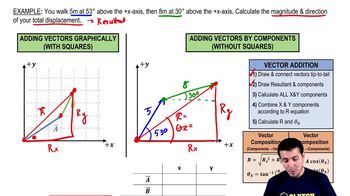
Vector Addition By Components

Magnitude of a Vector

The magnitude of a vector is a measure of its length and is calculated using the Pythagorean theorem. For a vector represented as A = Ai + Aj, the magnitude |A| is given by |A| = √(Ax² + Ay²). This value indicates how far the vector extends in space, regardless of its direction.
Recommended video:
Guided course
03:59
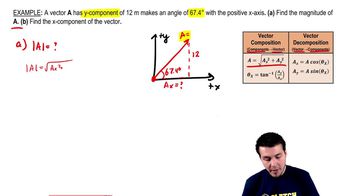
Calculating Magnitude & Components of a Vector

Direction of a Vector

The direction of a vector indicates the orientation in which it acts and is often expressed as an angle relative to a reference axis. For a vector A = Ai + Aj, the direction can be found using the tangent function: θ = arctan(Ay/Ax). This angle helps in understanding how the vector is positioned in a coordinate system.
Recommended video:
Guided course
06:44
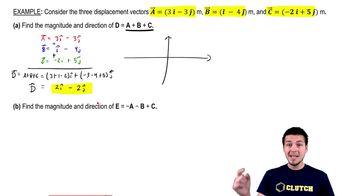
Adding 3 Vectors in Unit Vector Notation