Ch 03: Vectors and Coordinate Systems
Knight Calc - Physics for Scientists and Engineers 5th Edition
Knight Calc5th EditionPhysics for Scientists and EngineersISBN: 9780137344796Not the one you use?Change textbook
Chapter 3, Problem 22c

Let A=(3.0m,20south of east),B=(2.0m,north)\(\mathbf{A}\) = (3.0 \, \(\text{m}\), 20^\(\circ\) \, \(\text{south of east}\)), \(\quad\) \(\mathbf{B}\) = (2.0 \, \(\text{m}\), \(\text{north}\)), and C=(5.0m,70south of west)\(\mathbf{C}\) = (5.0 \, \(\text{m}\), 70^\(\circ\) \, \(\text{south of west}\)). Find the magnitude and the direction of D=A+B+C\(\mathbf{D}\) = \(\mathbf{A}\) + \(\mathbf{B}\) + \(\mathbf{C}\).

Verified step by step guidance
1
Break each vector into its components. For vector A, calculate the x-component as A_x = A * cos(20°) and the y-component as A_y = -A * sin(20°) (negative because it is south of east). For vector B, since it points directly north, its x-component is B_x = 0 and its y-component is B_y = B. For vector C, calculate the x-component as C_x = -C * cos(70°) (negative because it is west) and the y-component as C_y = -C * sin(70°) (negative because it is south).
Add the x-components of all three vectors to find the x-component of D: D_x = A_x + B_x + C_x.
Add the y-components of all three vectors to find the y-component of D: D_y = A_y + B_y + C_y.
Calculate the magnitude of vector D using the Pythagorean theorem: |D| = sqrt(D_x^2 + D_y^2).
Determine the direction of vector D by calculating the angle θ using the formula θ = arctan(D_y / D_x). Adjust the angle based on the signs of D_x and D_y to ensure it is in the correct quadrant.

Verified video answer for a similar problem:

This video solution was recommended by our tutors as helpful for the problem above.
Video duration:
7m
Was this helpful?

Key Concepts

Here are the essential concepts you must grasp in order to answer the question correctly.

Vector Addition

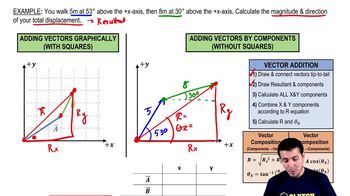
Vector addition involves combining multiple vectors to find a resultant vector. This process requires breaking each vector into its components, typically along the x (horizontal) and y (vertical) axes. The components are then summed separately to obtain the total x and y components of the resultant vector.
Recommended video:
Guided course
07:30
Vector Addition By Components

Trigonometric Functions

Trigonometric functions, such as sine and cosine, are essential for resolving vectors into their components based on their angles. For a vector at an angle θ, the x-component can be found using the cosine function (A_x = A * cos(θ)), and the y-component using the sine function (A_y = A * sin(θ)). This allows for accurate calculations of vector magnitudes and directions.
Recommended video:
Guided course
08:30
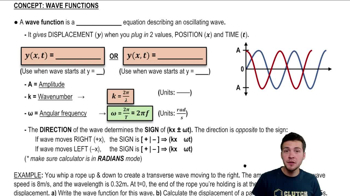
Intro to Wave Functions

Magnitude and Direction of a Vector

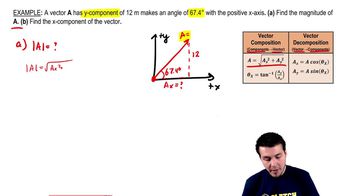
The magnitude of a vector represents its length or size, while the direction indicates the angle at which it acts. After calculating the resultant vector's components, the magnitude can be found using the Pythagorean theorem (|D| = √(D_x² + D_y²)), and the direction can be determined using the arctangent function (θ = arctan(D_y / D_x)), which gives the angle relative to a reference axis.
Recommended video:
Guided course
03:59
Calculating Magnitude & Components of a Vector