
Ch 02: Kinematics in One Dimension
Knight Calc - Physics for Scientists and Engineers 5th Edition
Knight Calc5th EditionPhysics for Scientists and EngineersISBN: 9780137344796Not the one you use?Change textbook
Chapter 2, Problem 62

A steel ball rolls across a 30-cm-wide felt pad, starting from one edge. The ball's speed has dropped to half after traveling 20 cm. Will the ball stop on the felt pad or roll off?

Verified step by step guidance
1
Step 1: Identify the given values and the physical principles involved. The ball's initial speed decreases to half after traveling 20 cm. The width of the felt pad is 30 cm. The problem involves deceleration due to friction, and we need to determine if the ball stops before reaching the edge of the pad.
Step 2: Use the kinematic equation for motion under constant acceleration: v'2 = v2 + 2ad, where v is the initial velocity, v' is the final velocity, a is the acceleration, and d is the distance traveled. Rearrange the equation to solve for acceleration a using the first part of the motion (20 cm).
Step 3: Substitute the known values into the equation. The ball's speed drops to half, so v' = 0.5v. The distance traveled is d = 20 cm. Solve for a.
Step 4: Use the calculated acceleration to determine if the ball stops before reaching the edge of the felt pad. Apply the kinematic equation again for the remaining distance (d = 30 - 20 = 10 cm) to find the final velocity v' at the edge of the pad.
Step 5: Analyze the result. If v' is zero or negative, the ball stops before reaching the edge. If v' is positive, the ball rolls off the pad. Interpret the physical meaning of the result based on the calculations.

Verified video answer for a similar problem:

This video solution was recommended by our tutors as helpful for the problem above.
Video duration:
10m
Was this helpful?

Key Concepts

Here are the essential concepts you must grasp in order to answer the question correctly.

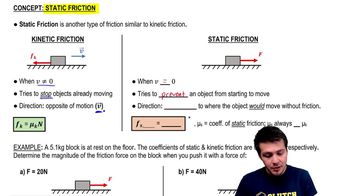
Friction

Friction is the force that opposes the relative motion of two surfaces in contact. In this scenario, the felt pad exerts a frictional force on the steel ball, which slows it down as it rolls across the surface. The amount of friction depends on the materials involved and the normal force acting on the ball. Understanding friction is crucial to determine how it affects the ball's motion and whether it will stop or continue rolling.
Recommended video:
Guided course
08:11
Static Friction & Equilibrium

Kinetic Energy and Work Done

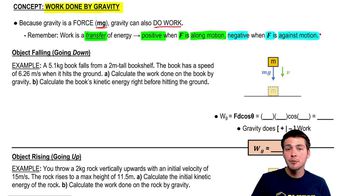
Kinetic energy is the energy possessed by an object due to its motion, calculated as 1/2 mv², where m is mass and v is velocity. As the ball rolls across the felt pad, work is done against friction, converting kinetic energy into thermal energy, which slows the ball down. Analyzing the relationship between the ball's initial kinetic energy and the work done by friction helps predict whether the ball will stop before reaching the edge of the pad.
Recommended video:
Guided course
06:34
Work Done By Gravity

Deceleration

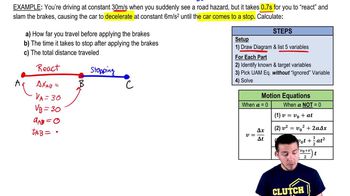
Deceleration refers to the rate at which an object slows down, often expressed as a negative acceleration. In this case, the ball experiences deceleration due to the frictional force from the felt pad. By understanding the deceleration and the distance traveled, we can calculate how much the ball's speed decreases and determine if it will stop before reaching the end of the pad or if it will roll off.
Recommended video:
Guided course
08:35
Acceleration with Multiple Parts
Related Practice
Textbook Question

You are 9.0 m from the door of your bus, behind the bus, when it pulls away with an acceleration of 1.0 m/s². You instantly start running toward the still-open door at 4.5 m/s. What is the maximum time you can wait before starting to run and still catch the bus?

2
views
Textbook Question

Ann and Carol are driving their cars along the same straight road. Carol is located at x = 2.4 mi at t = 0 h and drives at a steady 36 mph. Ann, who is traveling in the same direction, is located at x = 0.0 mi at t = 0.50 h and drives at a steady 50 mph. Draw a position-versus-time graph showing the motion of both Ann and Carol.

3
views
Textbook Question

A hotel elevator ascends 200 m with a maximum speed of 5.0 m/s. Its acceleration and deceleration both have a magnitude of 1.0 m/s2. How long does it take to make the complete trip from bottom to top?

Textbook Question

A motorist is driving at 20 m/s when she sees that a traffic light 200 m ahead has just turned red. She knows that this light stays red for 15 s, and she wants to reach the light just as it turns green again. It takes her 1.0 s to step on the brakes and begin slowing. What is her speed as she reaches the light at the instant it turns green?

1
views
Textbook Question

FIGURE P2.64 shows a fixed vertical disk of radius R. A thin, frictionless rod is attached to the bottom point of the disk and to a point on the edge, making angle Φ (Greek phi) with the vertical. Find an expression for the time it takes a bead to slide from the top end of the rod to the bottom.

1
views
Textbook Question

A very slippery block of ice slides down a smooth ramp tilted at angle θ. The ice is released from rest at vertical height h above the bottom of the ramp. Find an expression for the speed of the ice at the bottom.

1
views