

Ch. 43 - Elementary Particles
Giancoli Douglas - Physics for Scientists and Engineers 5th edition
Giancoli Douglas5th editionPhysics for Scientists and EngineersISBN: 9780137488179Not the one you use?Change textbook
Chapter 38, Problem 49

The mean lifetimes listed in Table 43–2 are in terms of proper time, measured in a reference frame where the particle is at rest. If a tau lepton is created with a kinetic energy of 920 MeV, how long would its track be as measured in the lab, on average, ignoring any collisions?

Verified step by step guidance
1
Identify the given data: The kinetic energy of the tau lepton is 920 MeV, and we need to calculate the average track length in the lab frame. The proper lifetime of the tau lepton (τ₀) can be found in Table 43–2. The problem involves relativistic time dilation and the relationship between energy, momentum, and velocity.
Calculate the total energy of the tau lepton in the lab frame using the formula: E=K+mc2, where K is the kinetic energy (920 MeV) and mc2 is the rest energy of the tau lepton (also found in Table 43–2).
Determine the Lorentz factor (γ) using the formula: γ=Emc2. This factor accounts for the relativistic effects due to the high velocity of the tau lepton.
Calculate the dilated lifetime in the lab frame using the formula: τ=γτ, where τ is the proper lifetime of the tau lepton.
Determine the average track length in the lab frame using the formula: L=vτ, where v is the velocity of the tau lepton (calculated from its total energy and momentum) and τ is the dilated lifetime.

Verified video answer for a similar problem:

This video solution was recommended by our tutors as helpful for the problem above.
Video duration:
6m
Was this helpful?

Key Concepts

Here are the essential concepts you must grasp in order to answer the question correctly.

Proper Time

Proper time is the time interval measured by a clock that is at rest relative to the event being timed. In particle physics, it is the time experienced by a particle in its own rest frame. This concept is crucial for understanding how time is perceived differently depending on the observer's frame of reference, especially in relativistic contexts.
Recommended video:
Guided course
07:49
Proper Frames and Measurements

Time Dilation

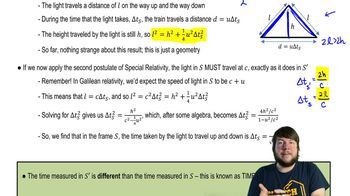
Time dilation is a phenomenon predicted by Einstein's theory of relativity, where time is observed to run slower for an object moving at high speeds compared to a stationary observer. This effect becomes significant as the object's velocity approaches the speed of light, impacting the measurement of lifetimes and distances in high-energy particle physics.
Recommended video:
Guided course
12:57
Time Dilation

Kinetic Energy and Relativistic Effects

Kinetic energy in the context of relativistic physics refers to the energy an object possesses due to its motion, which increases significantly as its speed approaches the speed of light. For particles like the tau lepton, high kinetic energy affects both its lifetime and the distance it travels before decaying, necessitating the use of relativistic equations to accurately calculate these values.
Recommended video:
Guided course
06:07
Intro to Rotational Kinetic Energy