
Ch. 32 - Light: Reflection and Refraction
Giancoli Douglas - Physics for Scientists and Engineers 5th edition
Giancoli Douglas5th editionPhysics for Scientists and EngineersISBN: 9780137488179Not the one you use?Change textbook
Chapter 31, Problem 69

The critical angle of a certain piece of plastic in air is θC = 35.8°. What is the critical angle of the same plastic if it is immersed in water?

Verified step by step guidance
1
Step 1: Recall the formula for the critical angle, which is given by: θC=sin-1(n2n1), where n1 is the refractive index of the medium in which the light is initially traveling, and n2 is the refractive index of the second medium.
Step 2: For the given problem, the critical angle in air is θC=35.8°. Use this to find the refractive index of the plastic. Rearrange the critical angle formula to solve for n1 (plastic): n1=n2/sin(θC), where n2 is the refractive index of air (approximately 1.00).
Step 3: Once the refractive index of the plastic is determined, consider the new situation where the plastic is immersed in water. The refractive index of water is approximately n2=1.33. Use the critical angle formula again: θC=sin-1(n2n1), where n1 is the refractive index of the plastic and n2 is the refractive index of water.
Step 4: Substitute the values of n1 (plastic) and n2 (water) into the critical angle formula to calculate the new critical angle. Ensure that the sine inverse function is applied correctly.
Step 5: Interpret the result. The new critical angle will be smaller than the original critical angle in air because the refractive index of water is greater than that of air, which reduces the ratio n2n1.

Verified video answer for a similar problem:

This video solution was recommended by our tutors as helpful for the problem above.
Video duration:
3m
Was this helpful?

Key Concepts

Here are the essential concepts you must grasp in order to answer the question correctly.

Critical Angle

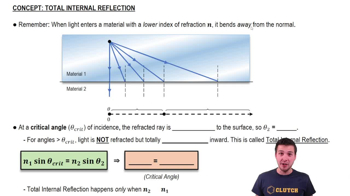
The critical angle is the angle of incidence above which total internal reflection occurs when light travels from a denser medium to a less dense medium. It is defined by the relationship sin(θ_C) = n2/n1, where θ_C is the critical angle, n1 is the refractive index of the denser medium, and n2 is that of the less dense medium.
Recommended video:
Guided course
01:04
Critical Angle

Refractive Index

The refractive index is a dimensionless number that describes how light propagates through a medium. It is defined as the ratio of the speed of light in a vacuum to the speed of light in the medium. Different materials have different refractive indices, which affect how light bends when entering or exiting the material.
Recommended video:
Guided course
03:46
Index of Refraction

Total Internal Reflection

Total internal reflection occurs when a light wave traveling in a denser medium hits the boundary with a less dense medium at an angle greater than the critical angle. Instead of refracting into the second medium, the light is completely reflected back into the denser medium, which is a principle used in optical fibers and various optical devices.
Recommended video:
Guided course
05:29
Total Internal Reflection
Related Practice
Textbook Question

A fish is swimming in water inside a thin spherical glass bowl of uniform thickness. Assuming the radius of curvature of the bowl is 32.0 cm, locate the image of the fish if the fish is located: (a) at the center of the bowl; (b) 20.0 cm from the side of the bowl between the observer and the center of the bowl. Assume the fish is small.

1
views
Textbook Question

Two plane mirrors are facing each other 2.2 m apart as in Fig. 32–60. You stand 1.5 m away from one of these mirrors and look into it. You will see multiple images of yourself. (a) How far away from you are the first three images of yourself in the mirror in front of you? (b) Are these first three images facing toward you or away from you?


<IMAGE>

2
views
Textbook Question

Two identical concave mirrors are set facing each other 1.0 m apart. A small lightbulb is placed halfway between the mirrors. A small piece of paper placed just to the left of the bulb prevents light from the bulb from directly shining on the left mirror, but light reflected from the right mirror still reaches the left mirror. A good image of the bulb appears on the left side of the piece of paper. What is the focal length of the mirrors?

Textbook Question

(c) Determine the magnification of a plane mirror in this same limit.

(d) Are your results in parts (b) and (c) consistent with the discussion of Section 32–2 on plane mirrors?

2
views
Textbook Question

A 1.80-m-tall person stands 4.20 m from a convex mirror and notices that he looks precisely half as tall as he does in a plane mirror placed at the same distance. What is the radius of curvature of the convex mirror? (Assume that θ ≈ θ .) [Hint: The viewing angle is half.]

2
views
Textbook Question

We wish to determine the depth of a swimming pool filled with water by measuring the width (x = 5.20m) and then noting that the bottom edge of the pool is just visible at an angle of 13.0° above the horizontal as shown in Fig. 32–61. Calculate the depth of the pool.


<IMAGE>

1
views