
Ch. 32 - Light: Reflection and Refraction
Giancoli Douglas - Physics for Scientists and Engineers 5th edition
Giancoli Douglas5th editionPhysics for Scientists and EngineersISBN: 9780137488179Not the one you use?Change textbook
Chapter 31, Problem 83

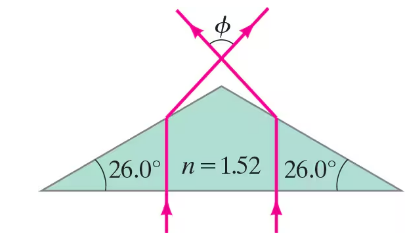
A triangular prism made of crown glass (n = 1.52) with base angles of 26.0° is surrounded by air. If parallel rays are incident normally on its base as shown in Fig. 32–66, what is the angle Φ between the two emerging rays?

Verified step by step guidance
1
Step 1: Understand the problem setup. The triangular prism is made of crown glass with a refractive index (n = 1.52) and base angles of 26.0°. Parallel rays are incident normally on the base of the prism, and we need to determine the angle Φ between the two emerging rays. The prism is surrounded by air, which has a refractive index of approximately 1.00.
Step 2: Apply Snell's Law at the first interface where the light enters the prism. Snell's Law is given by: n1sinθ=n2sinθ'. Here, n₁ is the refractive index of air (1.00), and n₂ is the refractive index of crown glass (1.52). Since the rays are incident normally, the angle of incidence θ is 0°, and the rays pass straight into the prism without bending.
Step 3: Determine the path of the rays inside the prism. The rays will strike the slanted surfaces of the prism at an angle equal to the base angle of the prism (26.0°). Use Snell's Law again at this interface to calculate the angle of refraction inside the prism. The equation is: n2sinθ'=n1sinθ'', where θ' is the angle of incidence inside the prism, and θ'' is the angle of refraction as the rays exit the prism.
Step 4: Calculate the angle of refraction for the emerging rays. At the second interface (where the rays exit the prism), use Snell's Law again to find the angle of refraction in air. The angle of incidence at this interface is determined by the geometry of the prism and the refracted angle inside the prism. The emerging rays will diverge, and the angle Φ between them can be calculated using the geometry of the prism and the refracted angles.
Step 5: Combine the results to find the angle Φ. The angle Φ is the sum of the angles between the two emerging rays. Use trigonometric relationships and the calculated angles of refraction to determine Φ. Ensure all angles are measured relative to the normal at each interface and consider the symmetry of the prism in your calculations.

Verified video answer for a similar problem:

This video solution was recommended by our tutors as helpful for the problem above.
Video duration:
5m
Was this helpful?

Key Concepts

Here are the essential concepts you must grasp in order to answer the question correctly.

Refraction

Refraction is the bending of light as it passes from one medium to another with a different refractive index. This phenomenon occurs because light travels at different speeds in different materials. In this case, light rays entering the crown glass prism from air will bend at the interface due to the difference in refractive indices (n = 1.52 for glass and approximately 1.00 for air).
Recommended video:
Guided course
03:46
Index of Refraction

Snell's Law

Snell's Law describes the relationship between the angles of incidence and refraction when light passes through different media. It is mathematically expressed as n1 * sin(θ1) = n2 * sin(θ2), where n1 and n2 are the refractive indices of the two media, and θ1 and θ2 are the angles of incidence and refraction, respectively. This law is essential for calculating the angles at which light rays emerge from the prism.
Recommended video:

Total Internal Reflection

Total internal reflection occurs when a light ray attempts to move from a denser medium to a less dense medium at an angle greater than the critical angle, resulting in the light being completely reflected back into the denser medium. In the context of the prism, understanding whether the light rays will undergo total internal reflection at the glass-air interface is crucial for determining the angle between the emerging rays.
Recommended video:
Guided course
05:29
Total Internal Reflection
Related Practice
Textbook Question

Light from a laser (in air) strikes the exact center of one face of a solid glass cube (n = 1.40) at an angle θ relative to the normal. The refracted beam travels inside the glass until it strikes an adjacent face of the cube. The original angle of incidence θ is such that no light exits the cube where the beam strikes the second face. What is the maximum value θ can have?

1
views
Textbook Question

Suppose Fig. 32–37 shows a cylindrical rod whose end has a radius of curvature R = 2.0 cm, and the rod is immersed in water with index of refraction of 1.33. The rod has index of refraction 1.49. Find the location and height of the image of an object 2.0 mm high located 23 cm away from the rod.

1
views
Textbook Question

An object is placed 21 cm from a certain mirror. The image is half the height of the object, inverted, and real. How far is the image from the mirror, and what is the radius of curvature of the mirror?

1
views
Textbook Question

A 1.80-m-tall person stands 4.20 m from a convex mirror and notices that he looks precisely half as tall as he does in a plane mirror placed at the same distance. What is the radius of curvature of the convex mirror? (Assume that θ ≈ θ .) [Hint: The viewing angle is half.]

2
views
Textbook Question

The label on a laser says it produces light of wavelength 670 nm. The laser beam passes through a block of plastic for which n = 1.57. What is the wavelength of the light inside the plastic?

1
views
Textbook Question

When light passes through a prism, the angle that the refracted ray makes relative to the incident ray is called the deviation angle δ, Fig. 32–64. Show that this angle is a minimum when the ray passes through the prism symmetrically, perpendicular to the bisector of the apex angle Φ, and show that the minimum deviation angle, δm, is related to the prism’s index of refraction n by


n=sin12(ϕ+δm)sinϕ/2.n = \(\frac{\sin \frac{1}{2}\)(\(\phi\) + \(\delta\)_m)}{\(\sin\) \(\phi\)/2}.


[Hint: For θ in radians, (d/dθ)(sin1θ)=1/1θ2(d/d\(\theta\)) (\(\sin\)^{-1}\(\theta\)) = 1/\(\sqrt{1 - \theta^2}\).]

1
views