
Ch. 30 - Inductance, Electromagnetic Oscillations, and AC Circuits
Giancoli Douglas - Physics for Scientists and Engineers 5th edition
Giancoli Douglas5th editionPhysics for Scientists and EngineersISBN: 9780137488179Not the one you use?Change textbook
Chapter 29, Problem 83

Show that the fraction of electromagnetic energy lost (to thermal energy) per cycle in a lightly damped (R² ≪ 4L/C) LRC circuit is approximately ΔUU=2πRLω=2πQ\(\frac{\Delta U}{U}\)=\(\frac{2\pi R}{L\omega}\)=\(\frac{2\pi}{Q}\). The quantity Q can be defined as Q = Lω/R, and is called the Q-value, or quality factor, of the circuit and is a measure of the damping present. A high Q-value means smaller damping and less energy input required to maintain oscillations.

Verified step by step guidance
1
Start by understanding the energy loss in an LRC circuit. The energy stored in the circuit oscillates between the inductor and capacitor, but due to the resistance (R), some energy is dissipated as thermal energy in each cycle.
The energy stored in the circuit at any given time is proportional to the square of the amplitude of the oscillating current or voltage. Let the total energy in the circuit be denoted as U. The energy lost per cycle, ΔU, is proportional to the resistance R and the current squared.
The Q-value (quality factor) is defined as \( Q = \frac{L \omega}{R} \), where \( L \) is the inductance, \( \omega \) is the angular frequency, and \( R \) is the resistance. A high Q-value corresponds to low damping and minimal energy loss per cycle.
The fraction of energy lost per cycle can be expressed as \( \frac{\Delta U}{U} \). Using the relationship between Q, R, and \( \omega \), and considering the lightly damped condition \( R^2 \ll \frac{4L}{C} \), we can derive that \( \frac{\Delta U}{U} \approx \frac{2\pi}{Q} \).
Substitute \( Q = \frac{L \omega}{R} \) into the expression for \( \frac{\Delta U}{U} \), and simplify to show that \( \Delta U \approx 2\pi R \cdot U \cdot \frac{1}{L \omega} \). This confirms the relationship between energy loss, resistance, and the Q-value in a lightly damped LRC circuit.

Verified video answer for a similar problem:

This video solution was recommended by our tutors as helpful for the problem above.
Video duration:
3m
Was this helpful?

Key Concepts

Here are the essential concepts you must grasp in order to answer the question correctly.

LRC Circuit

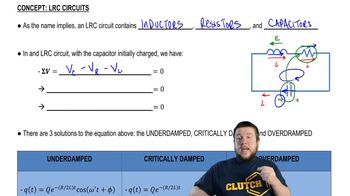
An LRC circuit consists of an inductor (L), a resistor (R), and a capacitor (C) connected in series or parallel. It exhibits oscillatory behavior due to the energy exchange between the inductor's magnetic field and the capacitor's electric field. The circuit's dynamics are governed by differential equations that describe how voltage and current change over time, leading to phenomena such as resonance and damping.
Recommended video:

Quality Factor (Q-value)

The quality factor, or Q-value, is a dimensionless parameter that quantifies the damping of an oscillating system, particularly in LRC circuits. It is defined as the ratio of the stored energy to the energy lost per cycle. A high Q-value indicates low energy loss and sharp resonance, while a low Q-value signifies higher damping and broader resonance peaks, affecting the circuit's performance in applications like filters and oscillators.
Recommended video:
Guided course
8:42
Density Values & Conversions

Damping and Energy Loss

Damping refers to the reduction of amplitude in oscillatory systems due to energy loss, often manifested as thermal energy in resistive components. In lightly damped systems, such as those with R² ≪ 4L/C, the energy loss per cycle is small compared to the total energy stored, allowing sustained oscillations. Understanding the relationship between resistance, inductance, and capacitance is crucial for analyzing how energy is dissipated in these circuits.
Recommended video:
Guided course
03:55
Energy Released by Flashbulb
Related Practice
Textbook Question

In some experiments, very tiny distances or spaces ( ≈ nm ) can be measured by using capacitance. Consider forming an LC circuit using a parallel-plate capacitor with plate area A, and a known inductance L. If f is on the order of 1 MHz and can be measured to a precision of ∆f = 1 Hz, with what percent accuracy can x be determined? Assume fringing effects at the capacitor’s edges can be neglected.

2
views
Textbook Question

An ac voltage source V = Vo sin (ωt + 90°) is connected across an inductor L and current I = Io sin (ωt) flows in this circuit. Note that the current and source voltage are 90° out of phase.

(a) Directly calculate the average power delivered by the source over one period T of its sinusoidal cycle via the integral P = ∫₀ᵀ VI dt/T.

(b) Apply the relation P = Iᵣₘₛ Vᵣₘₛ cos Φ to this circuit and show that the answer you obtain is consistent with that found in part (a). Comment on your results.

7
views
Textbook Question

An inductance coil draws 2.2 A dc when connected to a 45-V battery. When connected to a 60.0-Hz 120-V (rms) source, the current drawn is 3.8 A (rms). Determine the inductance and resistance of the coil.

1
views
Textbook Question

In some experiments, very tiny distances or spaces ( ≈ nm ) can be measured by using capacitance. Consider forming an LC circuit using a parallel-plate capacitor with plate area A, and a known inductance L. If charge is found to oscillate in this circuit at frequency f = ω/2π when the capacitor plates are separated by distance x, show that x = 4π² Aε₀f²L.

1
views
Textbook Question

In some experiments, very tiny distances or spaces ( ≈ nm ) can be measured by using capacitance. Consider forming an LC circuit using a parallel-plate capacitor with plate area A, and a known inductance L. When the plate separation is changed by ∆x, the circuit’s oscillation frequency will change by ∆f. Show that ∆x/x ≈ 2(∆f/f).

2
views
Textbook Question

For an underdamped LRC circuit, determine a formula for the energy U = UE + UB stored in the electric and magnetic fields as a function of time. Give answer in terms of the initial charge Qo on the capacitor.

1
views