
Ch. 28 - Sources of Magnetic Field
Giancoli Douglas - Physics for Scientists and Engineers 5th edition
Giancoli Douglas5th editionPhysics for Scientists and EngineersISBN: 9780137488179Not the one you use?Change textbook
Chapter 27, Problem 77a

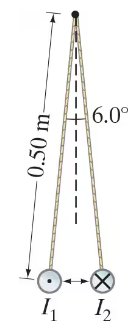
Two long straight aluminum wires, each of diameter 0.42 mm, carry the same current but in opposite directions. They are suspended by 0.50-m-long strings as shown in Fig. 28–66. If the suspension strings make an angle of 3.0° with the vertical and are hanging freely, what is the current in the wires?

Verified step by step guidance
1
Step 1: Analyze the forces acting on the wires. The wires are suspended by strings, and the forces include the tension in the strings, the gravitational force acting on the wires, and the magnetic force between the wires due to the currents flowing in opposite directions.
Step 2: Use the geometry of the setup to relate the angle of the strings (3.0°) to the horizontal magnetic force and the vertical gravitational force. The tension in the strings can be resolved into two components: vertical (balancing the weight of the wires) and horizontal (balancing the magnetic force).
Step 3: Calculate the gravitational force acting on each wire using the formula: Fg = mg, where m is the mass of the wire and g is the acceleration due to gravity. The mass can be determined using the density of aluminum and the volume of the wire.
Step 4: Use the formula for the magnetic force between two parallel currents: Fm = rac{\(\text{μ₀}\) I₁ I₂}{2πd} L, where I is the current, d is the distance between the wires, L is the length of the wires, and μ₀ is the permeability of free space.
Step 5: Combine the equations for the forces and use trigonometry to solve for the current. The horizontal component of the tension is equal to the magnetic force, and the vertical component is equal to the gravitational force. Use the tangent of the angle (3.0°) to relate these components: tan(θ) = rac{\(\text{Fₘ}\)}{\(\text{F₉}\)}. Substitute the expressions for Fm and Fg to solve for the current I.

Verified video answer for a similar problem:

This video solution was recommended by our tutors as helpful for the problem above.
Video duration:
9m
Was this helpful?

Key Concepts

Here are the essential concepts you must grasp in order to answer the question correctly.

Magnetic Force Between Current-Carrying Wires

When two parallel wires carry electric currents, they exert a magnetic force on each other. If the currents flow in the same direction, the wires attract; if they flow in opposite directions, they repel. This interaction is described by Ampère's force law, which quantifies the force per unit length between the wires based on the currents and the distance separating them.
Recommended video:
Guided course
09:57
Magnetic Force on Current-Carrying Wire

Tension and Angles in Suspended Wires

The tension in the strings supporting the wires must balance the forces acting on the wires, including the magnetic force and the weight of the wires. The angle of the strings with the vertical indicates that the tension has both vertical and horizontal components, which can be analyzed using trigonometric functions to resolve the forces acting on the system.
Recommended video:
Guided course
08:48
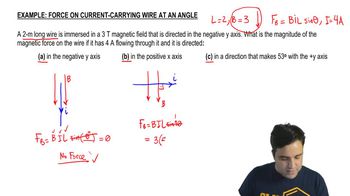
Find Force on Current-Carrying Wire at an Angle

Ohm's Law and Current Calculation

Ohm's Law relates the voltage (V), current (I), and resistance (R) in an electrical circuit, expressed as V = IR. In this scenario, knowing the resistance of the wires and the voltage applied can help determine the current flowing through them. The current can also be influenced by the magnetic forces acting on the wires, which must be considered when calculating the final current value.
Recommended video:
Guided course
03:07
Resistance and Ohm's Law
Related Practice
Textbook Question

The power cable for an electric trolley (Fig. 27–60) carries a horizontal current of 330 A toward the east. The Earth’s magnetic field has a strength 5.0 x 10⁻⁵ T and makes an angle of dip of 22° at this location. Calculate the magnitude and direction of the magnetic force on a 15-m length of this cable.


3
views
Textbook Question

Part of a long, thin insulated straight wire is formed into a single circular loop of radius 𝑅 (Fig. 28–68) and carries a current I. (a) What is the magnitude and direction of the magnetic field at the center of the loop? (b) If the plane of the loop is twisted 90 degrees so that the plane is perpendicular to the straight part of the wire (i.e., in the yz plane) what is the magnitude and direction of the field now at the center of the loop?

2
views
Textbook Question

You want to get an idea of the magnitude of magnetic fields produced by overhead power lines. You estimate that a transmission wire is about 12 m above the ground. The local power company tells you that the lines operate at 145 kV and provide a maximum of 45 MW to the local area. Estimate the maximum magnetic field you might experience walking under one such power line, and compare to the Earth’s field. [For an ac current, values are rms, and the magnetic field will be changing.]

1
views
Textbook Question

A toroid is fabricated with a circular shape and loops with a square cross section as shown in Fig. 28–69. The cross-section of a loop is a square of side 6.0 cm. The inner radius of the whole circular toroid is 3.0 m. There are 320 loops of wire which carry a 45-A dc current using a nearby power supply at 20.0 V. The arrows show the current flow in and out of the toroid. The current flows up at the inner diameter and down at the outer diameter. (a) Calculate the strength of the magnetic field at the center of the square’s cross section at point P. (b) Is the magnetic field pointing clockwise or counterclockwise? (c) The square cross-sectional area of the wire is uniformly 0.10 cm2. What is the resistivity of the wire?

1
views
Textbook Question

A set of Helmholtz coils (see Problem 62, Fig. 28–61) have a radius 𝑅 = 10.0 cm and are separated by a distance 𝑅 = 10.0 cm . Each coil has 85 loops carrying a current I = 2.0 A. Graph B as a function of 𝓍.

1
views