
Ch. 27 - Magnetism
Giancoli Douglas - Physics for Scientists and Engineers 5th edition
Giancoli Douglas5th editionPhysics for Scientists and EngineersISBN: 9780137488179Not the one you use?Change textbook
Chapter 26, Problem 3

(a) What is the force per meter of length on a straight wire carrying a 7.40-A current when perpendicular to a 0.90-T uniform magnetic field?
(b) What if the angle between the wire and field is 35.0°?

Verified step by step guidance
1
Step 1: Recall the formula for the magnetic force on a current-carrying wire: \( F = I L B \sin(\theta) \), where \( F \) is the magnetic force, \( I \) is the current, \( L \) is the length of the wire, \( B \) is the magnetic field strength, and \( \theta \) is the angle between the wire and the magnetic field.
Step 2: For part (a), the wire is perpendicular to the magnetic field, so \( \theta = 90^\circ \). The sine of \( 90^\circ \) is 1, simplifying the formula to \( F = I L B \). Since the problem asks for the force per meter of length, divide both sides of the equation by \( L \), giving \( \frac{F}{L} = I B \). Substitute \( I = 7.40 \ \mathrm{A} \) and \( B = 0.90 \ \mathrm{T} \) into the equation.
Step 3: For part (b), the angle between the wire and the magnetic field is \( \theta = 35.0^\circ \). Use the full formula \( F = I L B \sin(\theta) \). Again, since the problem asks for the force per meter of length, divide by \( L \), giving \( \frac{F}{L} = I B \sin(\theta) \). Substitute \( I = 7.40 \ \mathrm{A} \), \( B = 0.90 \ \mathrm{T} \), and \( \sin(35.0^\circ) \) into the equation.
Step 4: Use a calculator or trigonometric table to find \( \sin(35.0^\circ) \). This value will be used in the equation for part (b) to compute the force per meter of length.
Step 5: After substituting the values into the respective equations for parts (a) and (b), calculate the force per meter of length for each case. Ensure the units are consistent, and the final answer is expressed in \( \mathrm{N/m} \).

Verified video answer for a similar problem:

This video solution was recommended by our tutors as helpful for the problem above.
Video duration:
3m
Was this helpful?

Key Concepts

Here are the essential concepts you must grasp in order to answer the question correctly.

Magnetic Force on a Current-Carrying Wire

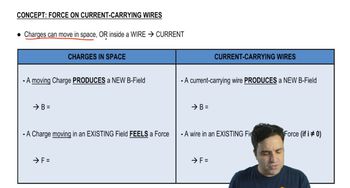
The magnetic force on a straight wire carrying an electric current is given by the formula F = I * L * B * sin(θ), where F is the force, I is the current in amperes, L is the length of the wire in meters, B is the magnetic field strength in teslas, and θ is the angle between the wire and the magnetic field. This relationship shows how the force depends on the current, the magnetic field, and the orientation of the wire.
Recommended video:
Guided course
09:57
Magnetic Force on Current-Carrying Wire

Uniform Magnetic Field

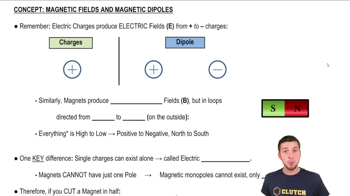
A uniform magnetic field is one in which the magnetic field strength and direction are constant throughout a given region. In this context, a 0.90-T uniform magnetic field means that the magnetic field has a strength of 0.90 teslas and is consistent in both magnitude and direction, which is crucial for calculating the force on the wire.
Recommended video:
Guided course
05:30
Magnetic Fields and Magnetic Dipoles

Angle in Magnetic Force Calculations

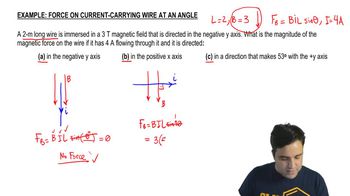
The angle θ in the magnetic force formula indicates the orientation of the wire relative to the magnetic field. When the wire is perpendicular to the field (θ = 90°), the force is maximized, as sin(90°) = 1. If the wire is at an angle, the effective component of the current interacting with the magnetic field decreases, affecting the overall force experienced by the wire.
Recommended video:
Guided course
08:48
Find Force on Current-Carrying Wire at an Angle