Ch. 26 - DC Circuits
Giancoli Douglas - Physics for Scientists and Engineers 5th edition
Giancoli Douglas5th editionPhysics for Scientists and EngineersISBN: 9780137488179Not the one you use?Change textbook
Chapter 25, Problem 20

[In these Problems neglect the internal resistance of a battery unless the Problem refers to it.]


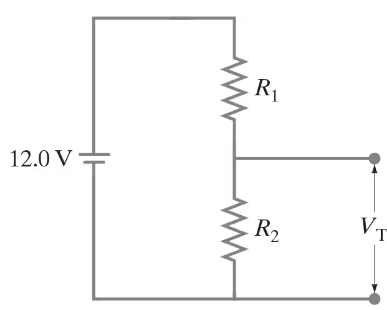
(II) A power supply has a fixed output voltage of 12.0 V, but you need VT = 3.0 V output for an experiment. (a) Using the voltage divider shown in Fig. 26–47, what should R₂ be if R₁ is 16.5 Ω? (b) What will the terminal voltage VT be if you connect a load to the 3.0-V output, assuming the load has a resistance of 7.0Ω?

Verified step by step guidance
1
Step 1: Understand the voltage divider circuit. The voltage divider uses two resistors, R₁ and R₂, connected in series across a voltage source. The output voltage VT is taken across R₂. The formula for VT is given by: VT=Vin×R2R1+R2, where Vin is the input voltage.
Step 2: For part (a), substitute the given values into the voltage divider formula. Vin = 12.0 V, VT = 3.0 V, and R₁ = 16.5 Ω. Rearrange the formula to solve for R₂: R2=R1×VTVin-VT. Plug in the values to find R₂.
Step 3: For part (b), when a load resistance RL = 7.0 Ω is connected in parallel with R₂, the effective resistance of R₂ changes. Use the formula for parallel resistances: Reff=R2×RLR2+RL. Calculate the effective resistance of R₂.
Step 4: Substitute the effective resistance of R₂ (Reff) back into the voltage divider formula: VT=Vin×ReffR1+Reff. This will give the new terminal voltage VT.
Step 5: Verify your calculations and ensure that the values make sense physically. The terminal voltage VT should decrease when the load is connected, as the effective resistance of R₂ decreases, causing a redistribution of the voltage.

Key Concepts

Here are the essential concepts you must grasp in order to answer the question correctly.

Voltage Divider Rule

The voltage divider rule is a fundamental principle in electrical engineering that describes how voltage is distributed across resistors in a series circuit. According to this rule, the output voltage across a resistor in series is a fraction of the total voltage, determined by the ratio of that resistor's resistance to the total resistance. This concept is crucial for calculating the desired output voltage (V_T) in the given circuit.
Recommended video:
Guided course
04:08
Kirchhoff's Junction Rule

Ohm's Law

Ohm's Law is a basic principle in electronics that relates voltage (V), current (I), and resistance (R) in a circuit, expressed as V = I × R. This law is essential for understanding how changes in resistance affect current flow and voltage across components. In this problem, it helps in analyzing the impact of the load resistance on the terminal voltage when connected to the output.
Recommended video:
Guided course
03:07
Resistance and Ohm's Law

Equivalent Resistance

Equivalent resistance is the total resistance of a circuit or a portion of a circuit, which can be calculated by combining resistors in series and parallel. In this scenario, understanding how to find the equivalent resistance of R1 and R2 is vital for determining the overall behavior of the circuit, especially when a load is connected, as it influences the voltage drop and current distribution.
Recommended video:
Guided course
03:44
Find Equivalent Capacitance #1
Related Practice
Textbook Question

[In these Problems neglect the internal resistance of a battery unless the Problem refers to it.]


(II) Determine the voltage across each resistor

1
views

Textbook Question

(III) If the 25-Ω resistor in Fig. 26–59 is shorted out (resistance = 0 ), what then would be the current through the 15-Ω resistor?

2
views
Textbook Question

[In these Problems neglect the internal resistance of a battery unless the Problem refers to it.]


(III) You are designing a wire resistance heater to heat an enclosed container of gas. For the apparatus to function properly, this heater must transfer heat to the gas at a very constant rate. While in operation, the resistance of the heater will always be close to the value R = R₀, but may fluctuate slightly causing its resistance to vary a small amount ∆R ( << R₀ ). To maintain the heater at constant power, you design the circuit shown in Fig. 26–50, which includes two resistors, each of resistance R′. Determine the value for R′ so that the heater power P will remain constant even if its resistance R fluctuates by a small amount. [Hint: If ∆R << R₀ , then ΔPΔRdPdRR=R0\(\Delta\) P\(\approx\) \(\Delta\) R\(\left\). \(\frac{dP}{dR}\]\right\)|_{R=R_{0}}]

1
views
Textbook Question

(II) (a) What is the potential difference between points a and d in Fig. 26–55 (similar to Fig. 26–12, Example 26–8), and (b) what is the terminal voltage of each battery?

1
views
Textbook Question

[In these Problems neglect the internal resistance of a battery unless the Problem refers to it.]


(II) What is the net resistance of the circuit connected to the battery in Fig. 26–46?

1
views
Textbook Question

[In these Problems neglect the internal resistance of a battery unless the Problem refers to it.]


(II) Determine the current through each resistor.

1
views