Ch. 23 - Electric Potential
Giancoli Douglas - Physics for Scientists and Engineers 5th edition
Giancoli Douglas5th editionPhysics for Scientists and EngineersISBN: 9780137488179Not the one you use?Change textbook
Chapter 22, Problem 85

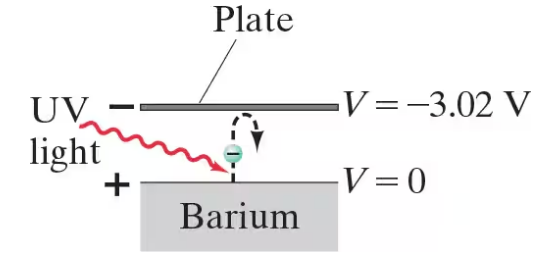
In a photocell, ultraviolet (UV) light provides enough energy to some electrons in barium metal to eject them from the surface at high speed. To measure the maximum energy of the electrons, another plate above the barium surface is kept at a negative enough potential that the emitted electrons are slowed down and stopped, and return to the barium surface. See Fig. 23–52. If the plate voltage is -3.02 V (compared to the barium) when the fastest electrons are stopped, what was the speed of these electrons when they were emitted?
Diagram showing a barium surface emitting electrons under UV light, with a plate at -3.02 V to measure electron speed.

Verified step by step guidance
1
Understand the problem: The question involves the photoelectric effect, where ultraviolet (UV) light ejects electrons from a metal surface. The stopping potential (V₀) is given as -3.02 V, and we need to calculate the speed of the fastest emitted electrons. The stopping potential is the voltage required to stop the fastest electrons, which relates to their maximum kinetic energy.
Recall the relationship between the stopping potential and the maximum kinetic energy of the electrons. The maximum kinetic energy (K.E.) of the electrons is given by the equation: Kmax = eV₀, where e is the elementary charge (1.60 × 10⁻¹⁹ C) and V0 is the stopping potential.
Relate the kinetic energy to the speed of the electrons. The kinetic energy of an electron is also given by the equation: Kmax = 1/2 mv², where m is the mass of the electron (9.11 × 10⁻³¹ kg) and v is the speed of the electron.
Combine the two equations to solve for the speed of the electron. Equating the two expressions for kinetic energy, we get: eV₀ = 1/2 mv². Rearrange this equation to solve for v: v = sqrt((2eV₀)/m).
Substitute the known values into the equation. Use e = 1.60 × 10⁻¹⁹ C, V0 = 3.02 V (magnitude of the stopping potential), and m = 9.11 × 10⁻³¹ kg. Plug these values into the formula to calculate the speed of the electron.

Verified video answer for a similar problem:

This video solution was recommended by our tutors as helpful for the problem above.
Video duration:
4m
Was this helpful?

Key Concepts

Here are the essential concepts you must grasp in order to answer the question correctly.

Photoelectric Effect

The photoelectric effect is the phenomenon where electrons are emitted from a material when it absorbs light of sufficient energy. In this case, ultraviolet light provides enough energy to barium metal, allowing electrons to overcome the work function and be ejected. This effect is fundamental in understanding how light interacts with matter and is crucial for analyzing the behavior of electrons in a photocell.
Recommended video:
Guided course
07:40
The Doppler Effect

Kinetic Energy of Electrons

The kinetic energy of an electron is the energy it possesses due to its motion, calculated using the formula KE = 1/2 mv², where m is the mass and v is the velocity of the electron. When electrons are emitted from the barium surface, they have a certain kinetic energy that can be related to the potential difference they encounter. Understanding this relationship is essential for determining the speed of the emitted electrons.
Recommended video:
Guided course
06:07
Intro to Rotational Kinetic Energy

Electric Potential and Work Done

Electric potential refers to the potential energy per unit charge at a point in an electric field. When a charged particle, such as an electron, moves through a potential difference, work is done on or by the particle. In this scenario, the negative potential of the plate slows down the emitted electrons, and the work done by this electric field can be used to calculate the initial kinetic energy of the electrons, which is directly related to their speed.
Recommended video:
Guided course
07:33
Electric Potential
Related Practice
Textbook Question

An analog voltage signal can vary from 0 V to 5.00 V, and it is to be converted to an 8-bit binary representation. What binary number would best represent 3.47 volts?

1
views

Textbook Question

The liquid-drop model of the nucleus suggests that high-energy oscillations of certain nuclei can split (“fission”) a large nucleus into two unequal fragments plus a few neutrons. Using this model, consider the case of a uranium nucleus fissioning into two spherical fragments, one with a charge q₁ = +38e and radius r₁ = 5.5 x 10⁻¹⁵ m, the other with q₂ = + 54e and r₂ = 6.2 x 10⁻¹⁵ m. Calculate the electric potential energy (MeV) of these fragments, assuming that the charge is uniformly distributed throughout the volume of each spherical nucleus and that their surfaces are initially in contact at rest. The electrons surrounding the nuclei can be neglected. This electric potential energy will then be entirely converted to kinetic energy as the fragments repel each other. How does your predicted kinetic energy of the fragments agree with the observed value associated with uranium fission (approximately 200 MeV total)? [ 1 MeV = 10⁶ eV.]

2
views
Textbook Question

Two point charges are fixed 4.0 cm apart from each other. Their charges are Q₁ = Q₂ = 6.5 μC and their masses are m₁ = 2.5 mg and m₂ = 3.5 mg. If Q₁ is released from rest, what will be its speed after a very long time?

3
views
Textbook Question

Near the surface of the Earth there is an electric field of about 150 V/m which points downward. Two identical balls with mass m = 0.550 kg are dropped from a height of 2.00 m, but one of the balls is positively charged with q₁ = 650 μC, and the second is negatively charged with q₂ = -650 μC. Use conservation of energy to determine the difference in the speeds of the two balls when they hit the ground. (Neglect air resistance.)

2
views
Textbook Question

An analog voltage signal can vary from 0 V to 5.00 V, and it is to be converted to an 8-bit binary representation. What voltage, to the nearest 0.01 V, would have a binary representation of 01110101?

1
views
Textbook Question

A Geiger counter is used to detect charged particles emitted by radioactive nuclei. It consists of a thin, positively charged central wire of radius Rₐ surrounded by a concentric conducting cylinder of radius Rᵦ with an equal negative charge (Fig. 23–57). The charge per unit length on the inner wire is λ (units C/m). The interior space between wire and cylinder is filled with low-pressure inert gas. Charged particles ionize some of these gas atoms; the resulting free electrons are attracted toward the positive central wire. If the radial electric field is strong enough, the freed electrons gain enough energy to ionize other atoms, causing an “avalanche” of electrons to strike the central wire, generating an electric “signal.” Find the expression for the electric field between the wire and the cylinder, and (b) show that the potential difference between Rₐ and Rᵦ is Vₐ - Vᵦ = ( λ / 2π∊₀ ) ln( Rᵦ/Rₐ) .

1
views