Ch. 23 - Electric Potential
Giancoli Douglas - Physics for Scientists and Engineers 5th edition
Giancoli Douglas5th editionPhysics for Scientists and EngineersISBN: 9780137488179Not the one you use?Change textbook
Chapter 22, Problem 38

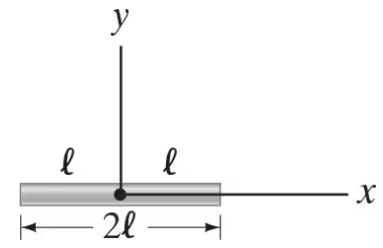
A thin rod of length 2ℓ is centered on the x axis as shown in Fig. 23–46. The rod carries a uniformly distributed charge Q. Determine the potential V as a function of y for points along the y axis. Let V = 0 at infinity.
Diagram of a charged rod on the x-axis, with labeled axes showing length 2ℓ and points along the y-axis for potential calculation.

Verified step by step guidance
1
Start by recalling the formula for the electric potential due to a point charge: \( V = \frac{k_e q}{r} \), where \( k_e \) is Coulomb's constant, \( q \) is the charge, and \( r \) is the distance from the charge to the point of interest. For a continuous charge distribution, the potential is calculated by integrating over the charge distribution: \( V = \int \frac{k_e dq}{r} \).
Set up the coordinate system. The rod is centered on the x-axis, with its length extending from \( -\ell \) to \( \ell \). The point of interest is along the y-axis at a distance \( y \) from the origin. The distance \( r \) from a point on the rod to the point on the y-axis is given by \( r = \sqrt{x^2 + y^2} \), where \( x \) is the position along the rod.
Express the charge element \( dq \) in terms of the linear charge density \( \lambda \), where \( \lambda = \frac{Q}{2\ell} \). The charge element is then \( dq = \lambda dx \), where \( dx \) is an infinitesimal segment of the rod.
Substitute \( dq \) and \( r \) into the integral for the potential: \( V = \int_{-\ell}^{\ell} \frac{k_e \lambda dx}{\sqrt{x^2 + y^2}} \). This integral accounts for the contribution to the potential from each infinitesimal segment of the rod.
Solve the integral. Since \( \lambda \) and \( k_e \) are constants, they can be factored out of the integral: \( V = k_e \lambda \int_{-\ell}^{\ell} \frac{dx}{\sqrt{x^2 + y^2}} \). Use a standard integral formula for \( \int \frac{dx}{\sqrt{x^2 + a^2}} \), which evaluates to \( \ln(x + \sqrt{x^2 + a^2}) \). Apply the limits of integration from \( -\ell \) to \( \ell \) to find the final expression for \( V \).

Verified video answer for a similar problem:

This video solution was recommended by our tutors as helpful for the problem above.
Video duration:
7m
Was this helpful?

Key Concepts

Here are the essential concepts you must grasp in order to answer the question correctly.

Electric Potential

Electric potential (V) is the amount of electric potential energy per unit charge at a point in an electric field. It is a scalar quantity and is measured in volts (V). The potential due to a charged object can be calculated by integrating the contributions from each infinitesimal charge element, taking into account the distance from the charge to the point of interest.
Recommended video:
Guided course
07:33
Electric Potential

Coulomb's Law

Coulomb's Law describes the force between two point charges. It states that the force (F) between two charges is directly proportional to the product of the magnitudes of the charges (Q1 and Q2) and inversely proportional to the square of the distance (r) between them. This law is fundamental in calculating the electric field and potential due to distributed charges.
Recommended video:
Guided course
09:52
Coulomb's Law

Superposition Principle

The superposition principle states that the total electric potential at a point due to multiple charges is the algebraic sum of the potentials due to each charge considered separately. This principle allows for the calculation of the potential from a continuous charge distribution, such as the uniformly charged rod in the question, by integrating the contributions from each infinitesimal segment of the rod.
Recommended video:
Guided course
03:32
Superposition of Sinusoidal Wave Functions
Related Practice
Textbook Question

Calculate the electric potential due to a tiny dipole whose dipole moment is 4.8 x 10⁻³⁰ Cm at a point 4.1 x 10⁻⁹ m away if this point is along the axis of the dipole nearer the positive charge.

1
views

Textbook Question

Suppose the end of your finger is charged.

(a) Estimate the breakdown voltage in air for your finger.

(b) About what surface charge density would have to be on your finger at this voltage?

2
views
Textbook Question

A very long conducting cylinder (length ℓ) of radius R₀ (R₀ ≪ ℓ) carries a uniform surface charge density σ (C/m²). The cylinder is at an electric potential V₀. Determine the potential, at points far from the end, at a distance R from the center of the cylinder for

(a) R > R₀

(b) R < R₀.

(c) Is V = 0 at R = ∞ (assume ℓ = ∞ )? Explain. [Hint: Recall Gauss’s law.]

2
views
Textbook Question

Calculate the electric potential due to a tiny dipole whose dipole moment is 4.8 x 10⁻³⁰ Cm at a point 4.1 x 10⁻⁹ m away if this point is 45° above the axis but nearer the positive charge.

1
views
Textbook Question

A metal sphere of radius r₀ = 0.35 m carries a charge Q = 0.50 μC. Equipotential surfaces are to be drawn for 100-V intervals outside the sphere. Determine the radius r of the first equipotential from the surface.

1
views
Textbook Question

Two point charges, 3.4 μC and -2.0 μC, are placed 8.0 cm apart on the x axis. At what points along the x axis are

(a) the electric field zero and

(b) the potential zero? Let V = 0 at r = ∞.

2
views