Textbook Question
A thermometer tells you that you have a fever of 38.5°C. What is this in Fahrenheit?
1
views

 Giancoli Douglas 5th editionCh. 17 - Temperature, Thermal Expansion, and the Ideal Gas LawProblem 11a
 Verified step by step guidance
 8:13
8:13
 05:21 05:21
A thermometer tells you that you have a fever of 38.5°C. What is this in Fahrenheit?
A uniform rectangular plate of length ℓ and width ω has a coefficient of linear expansion α. Show that, if we neglect very small quantities, the change in area of the plate due to a temperature change ∆T is ∆A = 2αℓω ∆T. See Fig. 17–21.
The Eiffel Tower (Fig. 17–20) is built of wrought iron approximately 300 m tall. Estimate how much its height changes between January (average temperature of 2°C) and July (average temperature of 25°C). Ignore the angles of the iron beams and treat the tower as a vertical beam.
<IMAGE>
At a given latitude, ocean water in the so-called mixed layer (from the surface to a depth of about 50 m) is at approximately the same temperature due to the mixing action of waves. Assume that because of global warming, the temperature of the mixed layer is everywhere increased by 0.5°C, while the temperature of the deeper portions of the ocean remains unchanged. Estimate the resulting rise in sea level. The ocean covers about 70% of the Earth’s surface.
In an alcohol-in-glass thermometer, the alcohol column has length 12.61 cm at 0.0°C and length 22.79 cm at 100.0°C. What is the temperature if the column has length 14.40 cm?
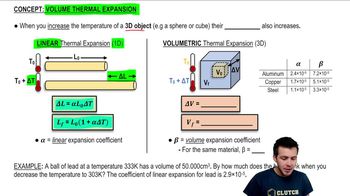
An aluminum sphere is 8.75 cm in diameter. What will be its % change in volume if it is heated from 30°C to 140°C?