Ch. 15 - Wave Motion
Giancoli Douglas - Physics for Scientists and Engineers 5th edition
Giancoli Douglas5th editionPhysics for Scientists and EngineersISBN: 9780137488179Not the one you use?Change textbook
Chapter 15, Problem 85a

Two strings on a musical instrument are tuned to play at 392 Hz (G) and 494 Hz (B). What are the frequencies of the first two overtones for each string?

Verified step by step guidance
1
Understand the concept of overtones: Overtones are the higher frequencies at which a string vibrates, in addition to its fundamental frequency. The first overtone is the second harmonic (2 times the fundamental frequency), and the second overtone is the third harmonic (3 times the fundamental frequency).
Identify the given fundamental frequencies: The first string has a fundamental frequency of 392 Hz, and the second string has a fundamental frequency of 494 Hz.
Calculate the first overtone (second harmonic) for each string: Use the formula \( f_{n} = n \cdot f_{1} \), where \( f_{1} \) is the fundamental frequency and \( n \) is the harmonic number. For the first overtone, \( n = 2 \). For the first string, \( f_{2} = 2 \cdot 392 \). For the second string, \( f_{2} = 2 \cdot 494 \).
Calculate the second overtone (third harmonic) for each string: Again, use the formula \( f_{n} = n \cdot f_{1} \). For the second overtone, \( n = 3 \). For the first string, \( f_{3} = 3 \cdot 392 \). For the second string, \( f_{3} = 3 \cdot 494 \).
Summarize the results: The first overtone for each string corresponds to the second harmonic, and the second overtone corresponds to the third harmonic. These frequencies are calculated by multiplying the fundamental frequency by 2 and 3, respectively.

Verified video answer for a similar problem:

This video solution was recommended by our tutors as helpful for the problem above.
Video duration:
3m
Was this helpful?

Key Concepts

Here are the essential concepts you must grasp in order to answer the question correctly.

Fundamental Frequency

The fundamental frequency is the lowest frequency at which a system oscillates, and it determines the pitch of the sound produced. In musical instruments, this frequency corresponds to the note being played. For the strings tuned to 392 Hz (G) and 494 Hz (B), these values represent their fundamental frequencies.
Recommended video:
Guided course
05:08
Circumference, Period, and Frequency in UCM

Overtones

Overtones are higher frequencies that occur at integer multiples of the fundamental frequency. The first overtone is typically the second harmonic, which is twice the fundamental frequency, while the second overtone is the third harmonic, three times the fundamental frequency. These overtones contribute to the timbre and richness of the sound produced by the strings.
Recommended video:
Guided course
06:28
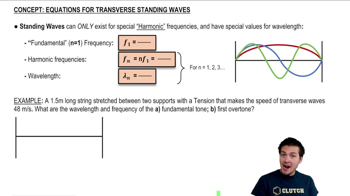
Equations for Transverse Standing Waves

Harmonic Series

The harmonic series is a sequence of frequencies that are integer multiples of a fundamental frequency. For a string fixed at both ends, the harmonics are produced by standing waves, where the first harmonic is the fundamental frequency, the second harmonic is the first overtone, and so on. Understanding this series is essential for calculating the frequencies of overtones for the given strings.
Recommended video:
Guided course
05:55
LRC Circuits in Series
Related Practice
Textbook Question

An earthquake-produced surface wave can be approximated by a sinusoidal transverse wave. Assuming a frequency of 0.60 Hz (typical of earthquakes, which actually include a mixture of frequencies), what amplitude is needed so that objects begin to leave contact with the ground? [Hint: Set the acceleration a > g. Why?]-

1
views
Textbook Question

Destructive interference occurs where two overlapping waves are 1/2 wavelength or 180° out of phase. Explain why 180° is equivalent to 1/2 wavelength.

1
views
Textbook Question

Dimensional analysis. Waves on the surface of the ocean do not depend significantly on the properties of water such as density or surface tension. The primary 'return force' for water piled up in the wave crests is due to the gravitational attraction of the Earth. Thus the speed v (m/s) of ocean waves depends on the acceleration due to gravity g. It is reasonable to expect that υ might also depend on water depth h and the wave's wavelength λ. Assume the wave speed is given by the functional form v = Cgᵅ hᵝ λᵞ, where α , β , c and C are numbers without dimension. In deep water, the water deep below the surface does not affect the motion of waves at the surface. Thus υ should be independent of depth h (i.e., β = 0). Using only dimensional analysis (Section 1–7 and Appendix D), determine the formula for the speed of surface ocean waves in deep water.

4
views
Textbook Question

Estimate the average power of a moving water wave that strikes the chest of an adult standing in the water at the seashore. Assume that the amplitude of the wave is 0.50 m, the wavelength is 2.5 m, and the period is 4.0 s.

1
views
Textbook Question

A transverse wave pulse travels to the right along a string with a speed v = 2.4 m/s. At t = 0 the shape of the pulse is given by the function D = 4.0m³ / (x² + 2.0m²), where D and x are in meters. Determine a formula for the wave pulse at any time t assuming the pulse is traveling to the left.

1
views