
Ch. 15 - Wave Motion
Giancoli Douglas - Physics for Scientists and Engineers 5th edition
Giancoli Douglas5th editionPhysics for Scientists and EngineersISBN: 9780137488179Not the one you use?Change textbook
Chapter 15, Problem 50

The speed of waves on a string is 96 m/s. If the frequency of standing waves is 435 Hz, how far apart are two adjacent nodes?

Verified step by step guidance
1
Step 1: Recall the relationship between wave speed, frequency, and wavelength. The formula is: v = fλ, where v is the wave speed, f is the frequency, and λ is the wavelength.
Step 2: Rearrange the formula to solve for the wavelength: λ = vf. Substitute the given values for wave speed (v = 96 m/s) and frequency (f = 435 Hz) into the equation.
Step 3: Calculate the wavelength λ. This represents the distance between two consecutive points in phase on the wave, such as two crests or two troughs.
Step 4: Recall that the distance between two adjacent nodes in a standing wave is half the wavelength. Use the relationship: d = λ2, where d is the distance between adjacent nodes.
Step 5: Substitute the calculated wavelength into the formula for d to determine the distance between adjacent nodes.

Verified video answer for a similar problem:

This video solution was recommended by our tutors as helpful for the problem above.
Video duration:
2m
Was this helpful?

Key Concepts

Here are the essential concepts you must grasp in order to answer the question correctly.

Wave Speed

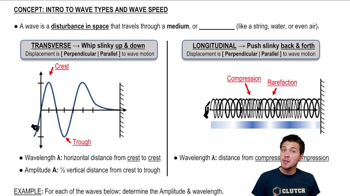
Wave speed is the distance traveled by a wave per unit time, calculated as the product of frequency and wavelength. In this case, the speed of waves on the string is given as 96 m/s, which is essential for determining the relationship between frequency and wavelength in standing waves.
Recommended video:
Guided course
07:19
Intro to Waves and Wave Speed

Frequency

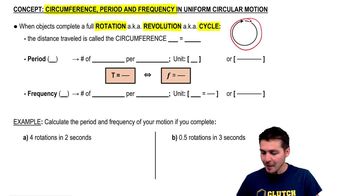
Frequency is the number of cycles of a wave that pass a point in one second, measured in hertz (Hz). In the question, the frequency of the standing waves is 435 Hz, which indicates how many complete wave cycles occur each second, influencing the wavelength and the distance between nodes.
Recommended video:
Guided course
05:08
Circumference, Period, and Frequency in UCM

Nodes and Wavelength

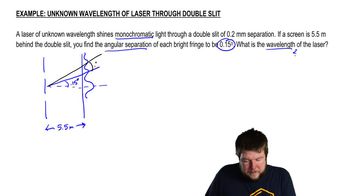
Nodes are points along a standing wave where the wave has minimal amplitude, occurring at regular intervals. The distance between two adjacent nodes is half the wavelength. By using the relationship between wave speed, frequency, and wavelength, one can calculate the distance between nodes in the standing wave.
Recommended video:
Guided course
05:42
Unknown Wavelength of Laser through Double Slit
Related Practice
Textbook Question

A guitar string is 91 cm long and has a mass of 3.2 g. The vibrating portion of the string from the bridge to the support post is ℓ = 64cm and the string is under a tension of 520 N. What are the frequencies of the fundamental and first two overtones?

1
views
Textbook Question

A particular string resonates in four loops at a frequency of 320 Hz. Name at least three other frequencies at which it will resonate. What is each called?

1
views
Textbook Question

One end of a horizontal string is attached to a small-amplitude mechanical 60.0-Hz oscillator. The string’s mass per unit length is 3.9 x 10⁻ ⁴ kg/m. The string passes over a pulley, a distance ℓ = 1.50 m away, and weights are hung from this end, Fig. 15–38. What mass m must be hung from this end of the string to produce five loops of a standing wave? Assume the string at the oscillator is a node, which is nearly true.

1
views
Textbook Question

Suppose two linear waves of equal amplitude and frequency have a phase difference ϕ as they travel in the same medium. They can be represented by: D₁ = A sin (kx - ωt); D₂ = A sin ( kx - ωt + ϕ). Describe the resultant wave, by equation and in words, if ϕ = π/2.

1
views
Textbook Question

Suppose two linear waves of equal amplitude and frequency have a phase difference ϕ as they travel in the same medium. They can be represented by: D₁ = A sin (kx - ωt); D₂ = A sin ( kx - ωt + ϕ). What is the amplitude of this resultant wave? Is the wave purely sinusoidal, or not?

Textbook Question

The displacement of a standing wave on a string is given by D = 2.4 sin ( 0.60x ) cos (42t) , where x and D are in centimeters and t is in seconds. What is the distance (cm) between nodes?

1
views