An 1150-kg automobile has springs with k = 14,000 N/m. One of the tires is not properly balanced; it has a little extra mass on one side compared to the other, causing the car to shake at certain speeds. If the tire radius is 42 cm, at what speed will the wheel shake most?
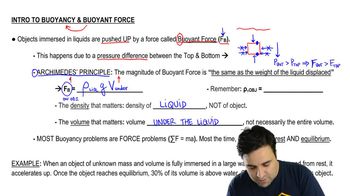
A 280-kg wooden raft floats on a lake. When a 68-kg man stands on the raft, it sinks 3.5 cm deeper into the water. When he steps off, the raft oscillates for a while. What is the total energy of oscillation (ignoring damping)?
Verified step by step guidance
Verified video answer for a similar problem:
Key Concepts
Buoyancy
Oscillation
Potential Energy
A clock pendulum oscillates at a frequency of 2.5 Hz. At t = 0, it is released from rest starting at an angle of 12° to the vertical. Ignoring friction, what will be the position (angle in radians) of the pendulum at t = 0.25 s?
In Section 14–5, the oscillation of a simple pendulum (Fig. 14–48) is viewed as linear motion along the arc length 𝓍 and analyzed via F = ma. Alternatively, the pendulum’s movement can be regarded as rotational motion about its point of support and analyzed using T = Iα. Carry out this alternative analysis and show that θ (t) = θₘₐₓ cos (t + θ), where θ (t) is the angular displacement of the pendulum from the vertical at time t, as long as its maximum value is less than about .
An energy-absorbing car bumper has a spring constant of 410 kN/m. Find the maximum compression of the bumper if the car, with mass 1300 kg, collides with a wall at a speed of 2.0 m/s (approximately 5 mi/h).
