
Ch. 13 - Fluids
Giancoli Douglas - Physics for Scientists and Engineers 5th edition
Giancoli Douglas5th editionPhysics for Scientists and EngineersISBN: 9780137488179Not the one you use?Change textbook
Chapter 13, Problem 99

Estimate the total mass of the Earth’s atmosphere, using the known value of atmospheric pressure at sea level.

Verified step by step guidance
1
Start by recalling that atmospheric pressure at sea level is approximately 101,325 Pa (Pascals). This pressure is caused by the weight of the column of air above a unit area of the Earth's surface.
Use the relationship between pressure, force, and area: \( P = \frac{F}{A} \), where \( P \) is pressure, \( F \) is force, and \( A \) is area. Rearrange this to find the total force exerted by the atmosphere: \( F = P \cdot A \).
The force \( F \) is equal to the weight of the atmosphere, which can be expressed as \( F = m \cdot g \), where \( m \) is the mass of the atmosphere and \( g \) is the acceleration due to gravity (approximately 9.8 m/s²). Combine this with the previous equation to get \( m = \frac{P \cdot A}{g} \).
To calculate the total mass, substitute the total surface area of the Earth into the equation. The surface area of a sphere is given by \( A = 4 \pi R^2 \), where \( R \) is the radius of the Earth (approximately 6.371 \(\times\) 10^6 \) meters).
Substitute the known values for \( P \), \( g \), and \( A \) into the equation \( m = \frac{P \cdot A}{g} \) to estimate the total mass of the Earth's atmosphere. Simplify the expression to find the result.

Verified video answer for a similar problem:

This video solution was recommended by our tutors as helpful for the problem above.
Video duration:
3m
Was this helpful?

Key Concepts

Here are the essential concepts you must grasp in order to answer the question correctly.

Atmospheric Pressure

Atmospheric pressure is the force exerted by the weight of air above a given point, typically measured at sea level. At sea level, this pressure is approximately 101,325 pascals (Pa). Understanding atmospheric pressure is crucial for estimating the mass of the atmosphere, as it relates directly to the weight of the air column above a specific area.
Recommended video:
Guided course
17:04
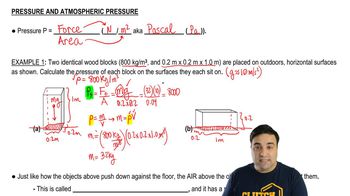
Pressure and Atmospheric Pressure

Area and Force Relationship

The relationship between force, area, and pressure is defined by the equation P = F/A, where P is pressure, F is force, and A is area. To estimate the total mass of the atmosphere, one can rearrange this equation to find the force (weight) exerted by the atmosphere over a specific area, which can then be used to calculate the total mass by dividing the force by the acceleration due to gravity.
Recommended video:
Guided course
03:43
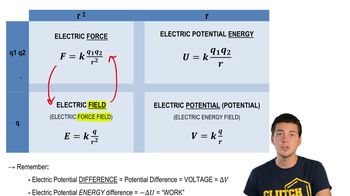
Relationships Between Force, Field, Energy, Potential

Mass Calculation from Pressure

To estimate the total mass of the atmosphere, one can multiply the atmospheric pressure at sea level by the surface area of the Earth. The total mass can be derived from the weight of the atmosphere, which is the product of pressure and area, divided by the acceleration due to gravity. This approach provides a practical method to quantify the mass of the atmosphere using readily available data.
Recommended video:
Guided course
13:11
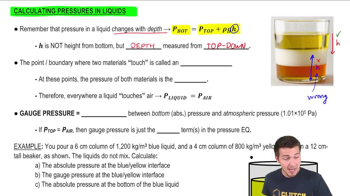
Calculating Pressure in Liquids