Ch. 12 - Static Equilibrium; Elasticity and Fracture
Giancoli Douglas - Physics for Scientists and Engineers 5th edition
Giancoli Douglas5th editionPhysics for Scientists and EngineersISBN: 9780137488179Not the one you use?Change textbook
Chapter 12, Problem 36

The Leaning Tower of Pisa is 55 m tall and about 7.7 m in radius. The top is 4.5 m off center. Is the tower in stable equilibrium? If so, how much farther can it lean before it becomes unstable? Assume the tower is of uniform composition.

Verified step by step guidance
1
Determine the condition for stable equilibrium: An object is in stable equilibrium if its center of gravity (CG) lies vertically above its base of support. For the tower, this means the CG must project within the base's radius (7.7 m).
Calculate the horizontal displacement of the center of gravity: The problem states that the top of the tower is 4.5 m off-center. Since the tower is of uniform composition, the CG will also shift horizontally by 4.5 m from the center of the base.
Compare the horizontal displacement of the CG to the radius of the base: If the horizontal displacement (4.5 m) is less than the radius of the base (7.7 m), the tower is in stable equilibrium. Otherwise, it is unstable.
Determine the maximum allowable horizontal displacement for stability: The CG can lean up to the edge of the base, which is 7.7 m from the center. Subtract the current displacement (4.5 m) from the maximum displacement (7.7 m) to find how much farther the tower can lean before becoming unstable.
Summarize the findings: Conclude whether the tower is currently in stable equilibrium and calculate the additional horizontal displacement it can tolerate before reaching the tipping point.

Verified video answer for a similar problem:

This video solution was recommended by our tutors as helpful for the problem above.
Video duration:
11m
Was this helpful?

Key Concepts

Here are the essential concepts you must grasp in order to answer the question correctly.

Stable Equilibrium

Stable equilibrium occurs when an object, if displaced slightly, will return to its original position. For a structure like the Leaning Tower of Pisa, this means that the center of mass must remain above its base of support. If the center of mass shifts outside the base, the structure will tip over, indicating instability.
Recommended video:
Guided course
10:13
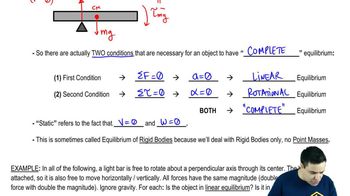
Torque & Equilibrium

Center of Mass

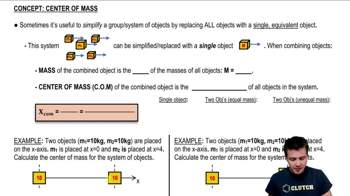
The center of mass is the point at which the mass of an object is concentrated and can be considered to act. For the Leaning Tower of Pisa, the center of mass is crucial in determining stability. If the center of mass is above the base of the tower, it remains stable; if it moves outside the base due to leaning, the tower risks falling.
Recommended video:
Guided course
06:30
Intro to Center of Mass

Moment of Inertia

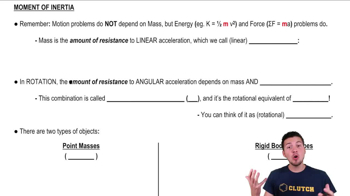
Moment of inertia is a measure of an object's resistance to changes in its rotation. In the context of the Leaning Tower of Pisa, a higher moment of inertia means the tower is less likely to tip over when subjected to forces. The distribution of mass relative to the axis of rotation affects how far the tower can lean before becoming unstable.
Recommended video:
Guided course
11:47
Intro to Moment of Inertia
Related Practice
Textbook Question

Assume the supports of the uniform cantilever shown in Fig. 12–79 (m = 2900 kg) are made of wood. Calculate the minimum cross-sectional area required of each, assuming a safety factor of 9.0.

1
views

Textbook Question

A refrigerator is approximately a uniform rectangular solid 1.9 m tall, 1.0 m wide, and 0.75 m deep. If it sits upright on a truck with its 1.0-m dimension in the direction of travel, and if the refrigerator cannot slide on the truck, how rapidly can the truck accelerate without tipping the refrigerator over? [Hint: The normal force would act at one corner.]

2
views
Textbook Question

A uniform rod AB of length 4.5 m and mass M = 3.8 kg is hinged at A and held in equilibrium by a light cord, as shown in Fig. 12–69. A load W = 22 N hangs from the rod at a distance d so that the tension in the cord is 85 N. Draw a free-body diagram for the rod.

1
views
Textbook Question

A 172-cm-tall person lies on a light (massless) board which is supported by two scales, one under the top of her head and one beneath the bottom of her feet (Fig. 12–65). The two scales read, respectively, 35.1 and 31.6 kg. What distance is the center of gravity of this person from the top of her head?

<IMAGE>

2
views
Textbook Question

A marble column of cross-sectional area 1.4m² supports a mass of 22,000 kg. By how much is the column shortened if it is 8.6 m high?

2
views
Textbook Question

A 15-cm-long tendon was found to stretch 3.7 mm by a force of 13.4 N. The tendon was approximately round with an average diameter of 8.5 mm. Calculate Young’s modulus of this tendon.