

Ch. 12 - Static Equilibrium; Elasticity and Fracture
Giancoli Douglas - Physics for Scientists and Engineers 5th edition
Giancoli Douglas5th editionPhysics for Scientists and EngineersISBN: 9780137488179Not the one you use?Change textbook
Chapter 12, Problem 55a

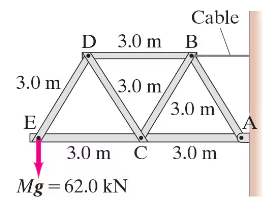
A heavy load Mg = 62.0 kN hangs at point E of the single cantilever truss shown in Fig. 12–81. Use a torque equation for the truss as a whole to determine the tension FT in the support cable, and then determine the force FA\(\overrightarrow{F_{A}\)} on the truss at pin A. Neglect the weight of the trusses, which is small compared to the load.
Diagram of a cantilever truss with a 62.0 kN load at point E and dimensions labeled, illustrating equilibrium concepts.

Verified step by step guidance
1
Identify the forces acting on the truss: The load at point E is given as \( M g = 62.0 \; \text{kN} \), the tension in the support cable is \( F_T \), and the reaction force at pin A is \( \vec{F}_A \). Neglect the weight of the truss itself.
Choose a pivot point for the torque calculation: To simplify the torque equation, select point A as the pivot. This eliminates the reaction force \( \vec{F}_A \) from the torque equation since its lever arm is zero.
Write the torque equation about point A: The torque due to the load \( M g \) at point E is \( \tau_E = M g \cdot d_E \), where \( d_E \) is the horizontal distance from point A to point E. The torque due to the tension \( F_T \) in the cable is \( \tau_T = F_T \cdot d_T \cdot \sin(\theta) \), where \( d_T \) is the length of the cable and \( \theta \) is the angle the cable makes with the horizontal. Set the sum of torques to zero for equilibrium: \( \tau_E - \tau_T = 0 \).
Solve for the tension \( F_T \): Rearrange the torque equation to isolate \( F_T \): \( F_T = \frac{M g \cdot d_E}{d_T \cdot \sin(\theta)} \). Substitute the known values for \( M g \), \( d_E \), \( d_T \), and \( \sin(\theta) \) to calculate \( F_T \).
Determine the reaction force \( \vec{F}_A \): Use the equilibrium conditions for forces. The vertical forces must balance: \( F_{A_y} + F_T \cdot \sin(\theta) = M g \). The horizontal forces must also balance: \( F_{A_x} = F_T \cdot \cos(\theta) \). Solve these equations to find the components of \( \vec{F}_A \), and combine them to find the magnitude and direction of \( \vec{F}_A \).

Verified video answer for a similar problem:

This video solution was recommended by our tutors as helpful for the problem above.
Video duration:
12m
Was this helpful?

Key Concepts

Here are the essential concepts you must grasp in order to answer the question correctly.

Torque

Torque is a measure of the rotational force applied to an object, calculated as the product of the force and the distance from the pivot point (lever arm). In the context of the cantilever truss, the torque equation helps determine the balance of forces around a pivot, allowing us to analyze how the load affects the tension in the support cable.
Recommended video:
Guided course
08:55
Net Torque & Sign of Torque

Equilibrium of Forces

In physics, an object is in equilibrium when the sum of all forces acting on it is zero. For the cantilever truss, this means that the upward forces (like tension in the cable) must balance the downward forces (like the weight of the load). Understanding this concept is crucial for solving for unknown forces in static structures.
Recommended video:

Free Body Diagram (FBD)

A Free Body Diagram is a graphical representation used to visualize the forces acting on an object. In analyzing the cantilever truss, drawing an FBD helps identify all forces, including the load, tension, and reactions at supports, which is essential for applying equilibrium conditions and solving for unknowns.
Recommended video:
Guided course
08:42
Free-Body Diagrams
Related Practice
Textbook Question

A 50-story building is being planned. It is to be 180.0 m high with a base 46.0 m by 76.0 m. Its total mass will be about 1.8 x 10⁷ kg, and its weight therefore about 1.8 x 10⁸ N. Suppose a 200-km/h wind exerts a force of 950N/m² over the 76.0-m-wide face (Fig. 12–86). Calculate the torque about the potential pivot point, the rear edge of the building (where FE\(\overrightarrow{F_{E}\)} acts in Fig. 12–86), and determine whether the building will topple. Assume the total force of the wind acts at the midpoint of the building’s face, and that the building is not anchored in bedrock. [Hint: FE\(\overrightarrow{F_{E}\)} in Fig. 12–86 represents the force that the Earth would exert on the building in the case where the building would just begin to tip.]

2
views
Textbook Question

Assume the supports of the uniform cantilever shown in Fig. 12–79 (m = 2900 kg) are made of wood. Calculate the minimum cross-sectional area required of each, assuming a safety factor of 9.0.

1
views
Textbook Question

A steel cable is to support an elevator whose total (loaded) mass is not to exceed 3100 kg. If the maximum acceleration of the elevator is 1.8 m/s² , calculate the diameter of cable required. Assume a safety factor of 8.0.

Textbook Question

The subterranean tension ring that surrounds the dome in Fig. 12–39 exerts the balancing horizontal force on the abutments for the dome and is 36-sided, so each segment makes a 10° angle with the adjacent one (Fig. 12–83). Calculate the tension F that must exist in each segment so that the required force of 4.2 x 10⁵ N can be exerted at each corner (Example 12–14).

1
views
Textbook Question

A pole projects horizontally from the front wall of a shop. A 6.1-kg sign hangs from the pole at a point 2.2 m from the wall (Fig. 12–88). What is the torque due to this sign calculated about the point where the pole meets the wall?

1
views
Textbook Question

A 15-cm-long tendon was found to stretch 3.7 mm by a force of 13.4 N. The tendon was approximately round with an average diameter of 8.5 mm. Calculate Young’s modulus of this tendon.