Ch. 10 - Rotational Motion
Giancoli Douglas - Physics for Scientists and Engineers 5th edition
Giancoli Douglas5th editionPhysics for Scientists and EngineersISBN: 9780137488179Not the one you use?Change textbook
Chapter 10, Problem 87b

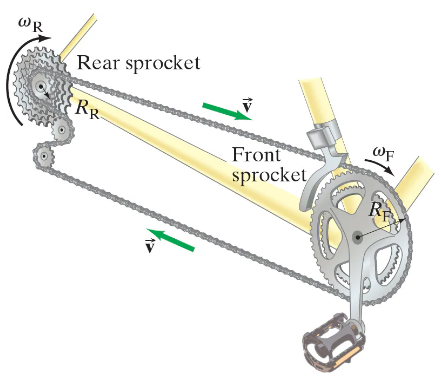
How is the angular velocity ωᵣ of the rear wheel of a bicycle related to the angular velocity ωբ of the front sprocket and pedals? Let Nբ and Nᵣ be the number of teeth on the front and rear sprockets, respectively, Fig. 10–71, and Rբ and Rᵣ their respective radii. The teeth are spaced the same on both sprockets and the rear sprocket is firmly attached to the rear wheel. Evaluate the ratio ωᵣ / ωբ when the front and rear sprockets have 52 and 13 teeth, respectively.
Diagram illustrating the relationship between the angular velocities of a bicycle's front and rear sprockets and their respective radii.

Verified step by step guidance
1
The relationship between the angular velocities of the front sprocket (ωբ) and the rear wheel (ωᵣ) is determined by the gear ratio. The gear ratio depends on the number of teeth on the front sprocket (Nբ) and the rear sprocket (Nᵣ). Since the teeth are evenly spaced, the number of teeth is proportional to the circumference of the sprockets.
The key principle here is that the chain moves the same linear distance on both sprockets in one revolution. This means the tangential velocity at the edge of the front sprocket is equal to the tangential velocity at the edge of the rear sprocket. Mathematically, this can be expressed as: vₜ = Rբ * ωբ = Rᵣ * ωᵣ, where Rբ and Rᵣ are the radii of the front and rear sprockets, respectively.
The number of teeth on a sprocket is proportional to its radius because the teeth are evenly spaced. Therefore, we can write: Rբ / Rᵣ = Nբ / Nᵣ. Substituting this into the tangential velocity equation, we get: ωբ / ωᵣ = Nᵣ / Nբ.
Rearranging the equation, we find the relationship between the angular velocities: ωᵣ / ωբ = Nբ / Nᵣ. This shows that the angular velocity of the rear wheel is directly proportional to the number of teeth on the front sprocket and inversely proportional to the number of teeth on the rear sprocket.
To evaluate the ratio ωᵣ / ωբ for the given values, substitute Nբ = 52 and Nᵣ = 13 into the equation: ωᵣ / ωբ = Nբ / Nᵣ. Simplify the fraction to find the ratio.

Verified video answer for a similar problem:

This video solution was recommended by our tutors as helpful for the problem above.
Video duration:
6m
Was this helpful?

Key Concepts

Here are the essential concepts you must grasp in order to answer the question correctly.

Angular Velocity

Angular velocity (ω) is a measure of how quickly an object rotates around an axis, expressed in radians per second. In the context of a bicycle, it describes the rate at which the pedals and wheels turn. The relationship between the angular velocities of different components, such as the front sprocket and rear wheel, is crucial for understanding how gear ratios affect speed and torque.
Recommended video:
Guided course
06:18
Intro to Angular Momentum

Gear Ratio

The gear ratio is the ratio of the number of teeth on two interacting gears, which determines how rotational motion is transferred between them. For a bicycle, the gear ratio between the front and rear sprockets influences the angular velocities of the pedals and the rear wheel. A higher gear ratio means the rear wheel turns faster for each pedal rotation, affecting the bicycle's speed and efficiency.
Recommended video:
Guided course
05:32
Ratio of energies of cylinder on surface

Relationship Between Angular Velocities

The relationship between the angular velocities of the front sprocket (ωᵇ) and the rear wheel (ωᵣ) can be expressed using the gear ratio. Specifically, the formula ωᵣ/ωᵇ = Nᵇ/Nᵣ indicates that the angular velocity of the rear wheel is inversely proportional to the number of teeth on the sprockets. This relationship allows cyclists to optimize their pedaling efficiency and speed by selecting appropriate gear combinations.
Recommended video:
Guided course
03:43
Relationships Between Force, Field, Energy, Potential
Related Practice
Textbook Question

A hollow cylinder (hoop) is rolling on a horizontal surface at speed v = 3.0 m/s when it reaches an 18° incline. How far up the incline will it go?

2
views

Textbook Question

The density (mass per unit length) of a thin rod of length ℓ increases uniformly from λ₀ at one end to 3λ₀ at the other end. Determine the moment of inertia about an axis perpendicular to the rod through its geometric center.

2
views
Textbook Question

A cyclist accelerates from rest at a rate of 1.00 m/s². How fast will a point at the top of the rim of the tire (diameter = 68.0 cm) be moving after 2.75 s? [Hint: At any moment, the lowest point on the tire is in contact with the ground and is at rest—see Fig. 10–69.]

2
views
Textbook Question

Bicycle gears:How is the angular velocity ωᵣ of the rear wheel of a bicycle related to the angular velocity ωբ of the front sprocket and pedals? Let Nբ and Nᵣ be the number of teeth on the front and rear sprockets, respectively, Fig. 10–71, and Rբ and Rᵣ their respective radii. The teeth are spaced the same on both sprockets and the rear sprocket is firmly attached to the rear wheel. Evaluate the ratio ωᵣ / ωբ when the front and rear sprocketshave 42 and 28 teeth.

4
views
Textbook Question

How is the angular velocity ωᵣ of the rear wheel of a bicycle related to the angular velocity ωբ of the front sprocket and pedals? Let Nբ and Nᵣ be the number of teeth on the front and rear sprockets, respectively, Fig. 10–71, and Rբ and Rᵣ their respective radii. The teeth are spaced the same on both sprockets and the rear sprocket is firmly attached to the rear wheel.

2
views
Textbook Question

On a 12.0-cm-diameter audio compact disc (CD), digital bits of information are encoded sequentially along an outward spiraling path. The spiral starts at radius R₁ = 2.5 cm and winds its way out to radius R₂ = 5.8 cm. To read the digital information, a CD player rotates the CD so that the player’s readout laser scans along the spiral’s sequence of bits at a constant linear speed of 1.25 m/s. Thus the player must accurately adjust the rotational frequency ƒ of the CD as the laser moves outward. Determine the values for ƒ (in units of rpm) when the laser is located at R₁ and when it is at R₂.

3
views