Ch. 10 - Rotational Motion
Giancoli Douglas - Physics for Scientists and Engineers 5th edition
Giancoli Douglas5th editionPhysics for Scientists and EngineersISBN: 9780137488179Not the one you use?Change textbook
Chapter 10, Problem 100

A 5.0-m-long ladder is leaning against the side of a building making a 35° angle with the building. When a person is about 1/3 of the way up, the ladder slips and falls to the ground in 3.0 s. What is the average angular acceleration of the ladder as it falls?

Verified step by step guidance
1
Identify the given values: The length of the ladder is 5.0 m, the angle with the building is 35°, and the time it takes for the ladder to fall is 3.0 s. The goal is to find the average angular acceleration (α).
Understand the relationship between angular displacement (θ), angular acceleration (α), and time (t). The ladder starts from rest, so its initial angular velocity (ω₀) is 0. Use the kinematic equation for rotational motion: θ = ω0t + 12αt2. Since ω0 = 0, the equation simplifies to θ = 12αt2.
Determine the angular displacement (θ) of the ladder as it falls. The ladder starts upright (90° or π2 radians) and ends flat on the ground (0 radians). Therefore, the total angular displacement is π2 radians.
Rearrange the simplified kinematic equation to solve for angular acceleration (α): α = 2θ1t2. Substitute the known values: θ = π2 radians and t = 3.0 s.
Simplify the expression to calculate the average angular acceleration (α). Ensure the units are consistent, and the result will be in radians per second squared (rad/s2).

Verified video answer for a similar problem:

This video solution was recommended by our tutors as helpful for the problem above.
Video duration:
7m
Was this helpful?

Key Concepts

Here are the essential concepts you must grasp in order to answer the question correctly.

Angular Acceleration

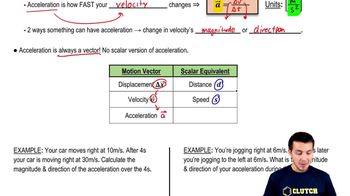
Angular acceleration is the rate of change of angular velocity over time. It is a vector quantity that indicates how quickly an object is rotating and how that rotation is changing. In this scenario, it is crucial to determine how fast the ladder's rotation increases as it falls, which can be calculated using the change in angular velocity divided by the time taken for the fall.
Recommended video:
Guided course
05:47
Intro to Acceleration

Kinematics of Rotational Motion

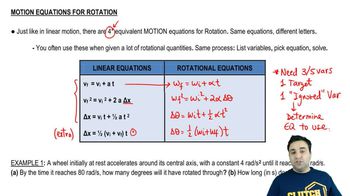
Kinematics of rotational motion describes the motion of objects that rotate around an axis. Key equations relate angular displacement, angular velocity, and angular acceleration, similar to linear motion. Understanding these relationships is essential for analyzing the ladder's fall, as it allows us to apply the appropriate kinematic equations to find the average angular acceleration during the fall.
Recommended video:
Guided course
07:18
Equations of Rotational Motion

Moment of Inertia

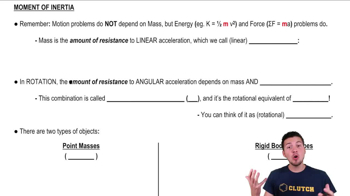
The moment of inertia is a measure of an object's resistance to changes in its rotational motion, depending on the mass distribution relative to the axis of rotation. For the ladder, its moment of inertia will influence how it accelerates as it falls. Knowing the moment of inertia is important for calculating the dynamics of the ladder's fall and understanding how mass and shape affect its angular acceleration.
Recommended video:
Guided course
11:47
Intro to Moment of Inertia
Related Practice
Textbook Question

A hollow cylinder (hoop) is rolling on a horizontal surface at speed v = 3.0 m/s when it reaches an 18° incline. How far up the incline will it go?

2
views

Textbook Question

The density (mass per unit length) of a thin rod of length ℓ increases uniformly from λ₀ at one end to 3λ₀ at the other end. Determine the moment of inertia about an axis perpendicular to the rod through its geometric center.

2
views
Textbook Question

Bicycle gears:How is the angular velocity ωᵣ of the rear wheel of a bicycle related to the angular velocity ωբ of the front sprocket and pedals? Let Nբ and Nᵣ be the number of teeth on the front and rear sprockets, respectively, Fig. 10–71, and Rբ and Rᵣ their respective radii. The teeth are spaced the same on both sprockets and the rear sprocket is firmly attached to the rear wheel. Evaluate the ratio ωᵣ / ωբ when the front and rear sprocketshave 42 and 28 teeth.

4
views
Textbook Question

A crucial part of a piece of machinery starts as a flat uniform cylindrical disk of radius R₀ and mass M. It then has a circular hole of radius R₁ drilled into it (Fig. 10–80). The hole’s center is a distance h from the center of the disk. Find the moment of inertia of this disk (with off-center hole) when rotated about its center, C. [Hint: Consider a solid disk and “subtract” the hole; use the parallel-axis theorem.]

Textbook Question

A cord connected at one end to a block which can slide on an inclined plane has its other end wrapped around a cylinder resting in a depression at the top of the plane as shown in Fig. 10–81. Determine the speed of the block after it has traveled 1.80 m along the plane, starting from rest. Assume there is no friction.

1
views