Ch. 07 - Work and Energy
Giancoli Douglas - Physics for Scientists and Engineers 5th edition
Giancoli Douglas5th editionPhysics for Scientists and EngineersISBN: 9780137488179Not the one you use?Change textbook
Chapter 7, Problem 15

A grocery cart with mass of 16 kg is pushed at constant speed up a 12° ramp by a force FP which acts at an angle of 17° below the horizontal. Find the work done by each of the forces (mg\(\overrightarrow{g}\), FN\(\overrightarrow{F_{N}\)}_{}, FN\(\overrightarrow{F_{N}\)}) on the cart if the ramp is 7.5 m long.

Verified step by step guidance
1
Step 1: Identify the forces acting on the cart. The forces are: (1) the gravitational force (m g→), which acts vertically downward, (2) the normal force (F_N→), which acts perpendicular to the surface of the ramp, and (3) the pushing force (F_P→), which acts at an angle of 17° below the horizontal.
Step 2: Break down the gravitational force (m g→) into components. The component parallel to the ramp is m g sin(θ), and the component perpendicular to the ramp is m g cos(θ), where θ = 12° is the angle of the ramp. These components will help determine the work done by gravity and the normal force.
Step 3: Calculate the work done by the gravitational force. Work is given by W = F d cos(φ), where F is the force, d is the displacement (7.5 m), and φ is the angle between the force and the displacement. For the gravitational force, φ = 180° - θ because the force is directed downward while the displacement is up the ramp.
Step 4: Determine the work done by the normal force (F_N→). Since the normal force is perpendicular to the displacement of the cart, the angle between the normal force and the displacement is 90°. The work done by a force perpendicular to the displacement is zero, so W_N = 0.
Step 5: Calculate the work done by the pushing force (F_P→). The pushing force has a component parallel to the ramp, which is F_P cos(17°), and a component perpendicular to the ramp, which is F_P sin(17°). Only the parallel component contributes to the work. Use W = F d cos(φ), where φ = 0° for the parallel component, to find the work done by F_P→.

Verified video answer for a similar problem:

This video solution was recommended by our tutors as helpful for the problem above.
Was this helpful?

Key Concepts

Here are the essential concepts you must grasp in order to answer the question correctly.

Work Done by a Force

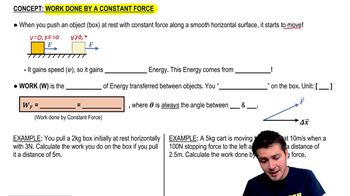
Work is defined as the product of the force applied to an object and the distance over which that force is applied, in the direction of the force. Mathematically, it is expressed as W = F * d * cos(θ), where θ is the angle between the force and the direction of motion. Understanding how to calculate work is essential for analyzing the forces acting on the grocery cart.
Recommended video:
Guided course
06:09
Work Done by a Constant Force

Components of Forces

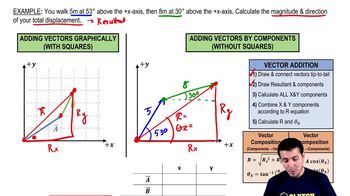
Forces acting at angles can be resolved into their horizontal and vertical components using trigonometric functions. For example, a force F at an angle θ can be broken down into F_x = F * cos(θ) and F_y = F * sin(θ). This concept is crucial for determining the effective forces acting on the cart as it moves up the ramp.
Recommended video:
Guided course
07:30
Vector Addition By Components

Gravitational Force and Normal Force

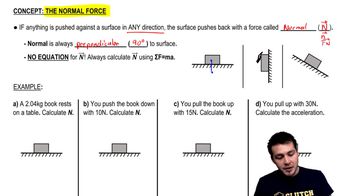
The gravitational force acting on an object is equal to its mass times the acceleration due to gravity (F_g = m * g). On an incline, this force can be resolved into components parallel and perpendicular to the ramp. The normal force (F_N) acts perpendicular to the surface and balances the perpendicular component of the gravitational force, which is vital for understanding the forces acting on the cart as it moves up the ramp.
Recommended video:
Guided course
08:17
The Normal Force
Related Practice
Textbook Question

Estimate the work you do to mow a lawn 10 m by 20 m with a 50-cm-wide mower. Assume you push with a horizontal force of about 15 N.

1
views

Textbook Question

A 2.0-kg block slides across a rough surface with a constant coefficient of kinetic friction of 0.50 (Fig. 7–38a). The block starts at x= 0 with an initial velocity of 4.9 m/s. Pushing the block is a force directed at 36.8° below the horizontal and whose magnitude increases with position as shown in Fig. 7–38b.

<IMAGE>

(d) Draw a line on the graph showing the magnitude of the friction force versus distance x.

Textbook Question

In a certain library the first shelf is 15.0 cm off the ground, and the remaining four shelves are each spaced 38.0 cm above the previous one. If the average book has a mass of 1.25 kg with a height of 22.0 cm, and an average shelf holds 28 books (standing vertically), how much work is required to fill all the shelves, assuming the books are all laying flat on the floor to start?

4
views
Textbook Question

Consider a force F₁ = A/xA/\(\sqrt{x}\) which acts on an object during its journey along the x axis from x = 0.0 to x = 1.0m, where A = 3.0 Nm¹⸍². Show that during this journey, even though F₁ is infinite at x = 0.0, the work W done on the object by this force is finite, and determine W.

1
views
Textbook Question

If the hill in Example 7–2 (Fig. 7–4) was not an even slope but rather an irregular curve as in Fig. 7–23, show that the same result would be obtained as in Example 7–2: namely, that the work done by gravity depends only on the height of the hill and not on its shape or the path taken.

1
views
Textbook Question

The net force exerted on a particle acts in the positive x direction. Its magnitude increases linearly from zero at x = 0, to 380 N at x = 3.0m. It remains constant at 380 N from x = 3.0m to x = 7.0m, and then decreases linearly to zero at x = 12.0m. Determine the work done to move the particle from x = 0 to x = 12.0m graphically, by determining the area under the Fₓ versus x graph.

4
views