Ch. 05 - Using Newton's Laws: Friction, Circular Motion, Drag Forces
Giancoli Douglas - Physics for Scientists and Engineers 5th edition
Giancoli Douglas5th editionPhysics for Scientists and EngineersISBN: 9780137488179Not the one you use?Change textbook
Chapter 5, Problem 88

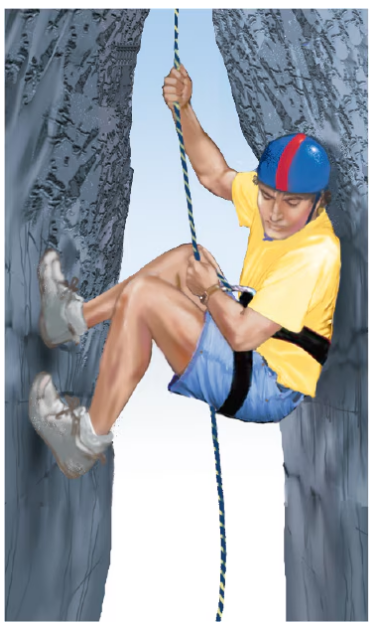
The 70.0-kg climber in Fig. 5–53 is supported in the 'chimney' by the friction forces exerted on his shoes and back. The static coefficients of friction between his shoes and the wall, and between his back and the wall, are 0.80 and 0.60, respectively. What is the minimum normal force he must exert? Assume the walls are vertical and that the static friction forces are both at their maximum. Ignore his grip on the rope.

Verified step by step guidance
1
Identify the forces acting on the climber: The climber is in equilibrium, so the forces acting on him must balance. The forces include his weight (gravitational force), the frictional forces from his shoes and back, and the normal forces exerted by the walls on his shoes and back.
Write the equilibrium conditions: Since the climber is stationary, the net force in both the vertical and horizontal directions must be zero. For the vertical direction, the upward frictional forces must balance the downward gravitational force. For the horizontal direction, the normal forces exerted by the walls on his shoes and back must balance each other.
Express the frictional forces: The frictional force is given by \( f = \mu N \), where \( \mu \) is the coefficient of static friction and \( N \) is the normal force. For the shoes, \( f_{shoes} = \mu_{shoes} N_{shoes} \), and for the back, \( f_{back} = \mu_{back} N_{back} \).
Set up the vertical force balance: The total upward frictional force must equal the climber's weight. This gives \( \mu_{shoes} N_{shoes} + \mu_{back} N_{back} = mg \), where \( m \) is the climber's mass and \( g \) is the acceleration due to gravity.
Set up the horizontal force balance: The normal forces exerted by the walls on the climber's shoes and back must be equal in magnitude but opposite in direction. This gives \( N_{shoes} = N_{back} \). Substitute this relationship into the vertical force balance equation to solve for the minimum normal force \( N \).

Verified video answer for a similar problem:

This video solution was recommended by our tutors as helpful for the problem above.
Video duration:
6m
Was this helpful?

Key Concepts

Here are the essential concepts you must grasp in order to answer the question correctly.

Static Friction

Static friction is the force that resists the initiation of sliding motion between two surfaces in contact. It acts parallel to the surfaces and is dependent on the normal force and the coefficient of static friction. The maximum static friction force can be calculated using the formula: F_friction = μ_s * N, where μ_s is the coefficient of static friction and N is the normal force.
Recommended video:
Guided course
08:11
Static Friction & Equilibrium

Normal Force

The normal force is the perpendicular force exerted by a surface to support the weight of an object resting on it. In this scenario, the climber exerts a normal force against the walls, which is crucial for generating the static friction needed to prevent slipping. The magnitude of the normal force directly influences the maximum static friction that can be achieved.
Recommended video:
Guided course
08:17
The Normal Force

Equilibrium Conditions

In physics, equilibrium refers to a state where the sum of forces and the sum of torques acting on an object are zero, resulting in no acceleration. For the climber, this means that the upward frictional forces must balance the downward gravitational force. Understanding equilibrium is essential to determine the minimum normal force required to maintain the climber's position without slipping.
Recommended video:
Guided course
10:13
Torque & Equilibrium
Related Practice
Textbook Question

A train traveling at a constant speed rounds a curve of radius 215 m. A lamp suspended from the ceiling swings out to an angle of 18.5° throughout the curve. What is the speed of the train? [Hint: See Example 4–15.]

1
views

Textbook Question

A coffee cup on the horizontal dashboard of a car slides forward when the driver decelerates from 45 km/h to rest in 3.5 s or less, but not if she decelerates in a longer time. What is the coefficient of static friction between the cup and the dash? Assume the road and the dashboard are level (horizontal).

2
views
Textbook Question

A car starts rolling down a 1-in-4 hill (1-in-4 means that for each 4 m traveled along the road, the elevation change is 1 m). How fast is it going when it reaches the bottom after traveling 55 m? Assume an effective coefficient of rolling friction equal to 0.10.

2
views
Textbook Question

The position of a particle moving in the xy plane is given by r\(\overrightarrow{r}\) = (2.0m) cos [(3.0 rad/s)t ] i^\(\hat{i}\) +(2.0m) sin [(3.0 rad/s)t ] j^\(\hat{j}\), where r is in meters and t is in seconds. Calculate the velocity and acceleration vectors as functions of time.

Textbook Question

A 28.0-kg block is connected to an empty 2.00-kg bucket by a cord running over a frictionless pulley (Fig. 5–56). The coefficient of static friction between the table and the block is 0.42 and the coefficient of kinetic friction between the table and the block is 0.34. Sand is gradually added to the bucket until the system just begins to move. Calculate the acceleration of the system.

Textbook Question

A pilot performs an evasive maneuver by diving vertically at a constant 310 m/s. If he can withstand an acceleration of 9.0 g’s without blacking out, at what altitude must he begin to pull his plane out of the dive (moving in a vertical circular path) to avoid crashing into the sea?

1
views