
(III) A 4.0-kg block is stacked on top of a 12.0-kg block, which is accelerating along a horizontal table at a = 5.2m/s2 (Fig. 5–43). Let μk = μs = μ. What is the force that must be applied to the 12.0-kg block in (a) and in (b), assuming that the table is frictionless?
Giancoli Douglas 5th edition
Ch. 05 - Using Newton's Laws: Friction, Circular Motion, Drag Forces
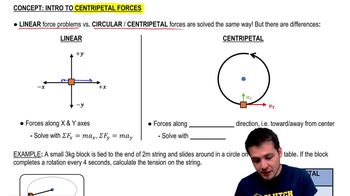
Problem 41On an ice rink two skaters of equal mass grab hands and spin in a mutual circle once every 2.5 s. If we assume their arms are each 0.80 m long and their individual masses are 55.0 kg, how hard are they pulling on one another?
Verified step by step guidance
Verified video answer for a similar problem:
Key Concepts
Centripetal Force
Tangential Velocity
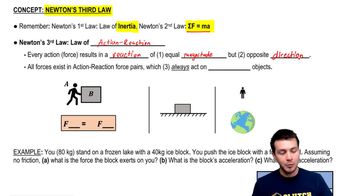
Newton's Third Law of Motion
Tarzan plans to cross a gorge by swinging in an arc from a hanging vine (Fig. 5–50). If his arms are capable of exerting a force of 1350 N on the vine, what is the maximum speed he can tolerate at the lowest point of his swing? His mass is 78 kg and the vine is 4.8 m long.
A jet plane traveling 1890 km/h (525 m/s) pulls out of a dive by moving in an arc of radius 4.80 km. What is the plane's acceleration in g's?
The position of a particle moving in the xy plane is given by = (2.0m) cos [(3.0 rad/s)t ] +(2.0m) sin [(3.0 rad/s)t ] , where r is in meters and t is in seconds. Calculate the velocity and acceleration vectors as functions of time.
A pilot performs an evasive maneuver by diving vertically at a constant 310 m/s. If he can withstand an acceleration of 9.0 g’s without blacking out, at what altitude must he begin to pull his plane out of the dive (moving in a vertical circular path) to avoid crashing into the sea?
Two blocks made of different materials connected together by a thin cord slide down a ramp inclined at an angle θ to the horizontal, Fig. 5–40 (block B is above block A). The masses of the blocks are mA and mB, and the coefficients of friction are μA and μB. If mA = mB = 4.0kg, and μA = 0.20 and μB = 0.30, determine the tension in the cord, for an angle θ = 32°.