Ch. 02 - Describing Motion: Kinematics in One Dimension
Giancoli Douglas - Physics for Scientists and Engineers 5th edition
Giancoli Douglas5th editionPhysics for Scientists and EngineersISBN: 9780137488179Not the one you use?Change textbook
Chapter 2, Problem 6a

A horse trots away from its trainer in a straight line, moving 38 m away in 7.4 s. It then turns abruptly and gallops halfway back in 1.8 s. Calculate its average speed

Verified step by step guidance
1
Step 1: Understand the concept of average speed. Average speed is defined as the total distance traveled divided by the total time taken. The formula is: vavg = dt, where d is the total distance and t is the total time.
Step 2: Calculate the total distance traveled by the horse. First, it moves 38 m away from the trainer. Then, it gallops halfway back, which is 382 = 19 m. Add these distances to find the total distance: dtotal = 38 + 19.
Step 3: Calculate the total time taken. The horse takes 7.4 s to move 38 m away and 1.8 s to gallop halfway back. Add these times to find the total time: ttotal = 7.4 + 1.8.
Step 4: Substitute the total distance and total time into the formula for average speed: vavg = dtotalttotal.
Step 5: Simplify the expression to find the average speed. Ensure the units are consistent (meters for distance and seconds for time) and express the result in meters per second (m/s).

Verified video answer for a similar problem:

This video solution was recommended by our tutors as helpful for the problem above.
Was this helpful?

Key Concepts

Here are the essential concepts you must grasp in order to answer the question correctly.

Average Speed

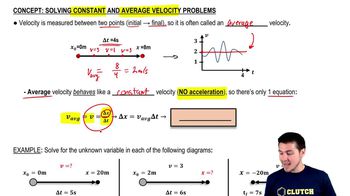
Average speed is defined as the total distance traveled divided by the total time taken. It provides a measure of how fast an object is moving over a specific period, regardless of the direction of travel. In this scenario, the horse's average speed can be calculated by considering both the distance it trotted away and the distance it galloped back.
Recommended video:
Guided course
05:44
Solving Constant and Average Velocity Problems

Distance and Displacement

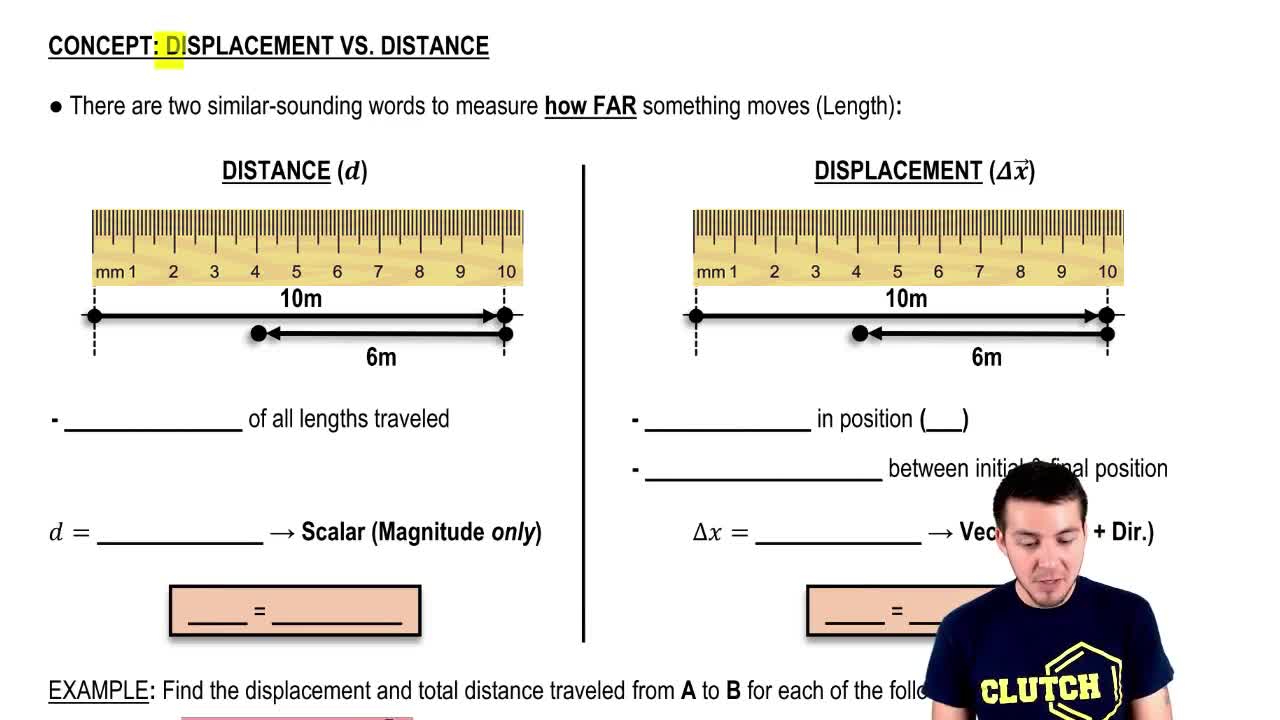
Distance refers to the total path length traveled by an object, while displacement is the straight-line distance from the initial to the final position, including direction. In this problem, the horse's total distance includes both the distance trotted away and the distance galloped back, which is essential for calculating average speed.
Recommended video:
Guided course
06:13
Displacement vs. Distance

Time Calculation

Time calculation involves summing the time intervals during which an object is in motion. In this case, the total time includes the time taken to trot away and the time taken to gallop back. Accurate time measurement is crucial for determining average speed, as it directly influences the speed calculation.
Recommended video:
Guided course
04:43
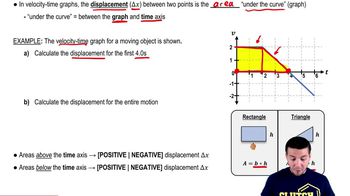
Calculating Displacement from Velocity-Time Graphs