Skip to main content
Physics with Calculus
My Course
Learn
Exam Prep
AI Tutor
Study Guides
Textbook Solutions
Flashcards
Explore
Try the app
My Course
Learn
Exam Prep
AI Tutor
Study Guides
Textbook Solutions
Flashcards
Explore
Try the app
Back
Physics: Units, Vectors, and Significant Figures
You can tap to flip the card.
What must physical quantities have in measurements?
You can tap to flip the card.
👆
What must physical quantities have in measurements?
Physical quantities must have
magnitude
and
units
.
Track progress
Control buttons has been changed to "navigation" mode.
1/26
Recommended videos
Guided course
06:06
Metric Prefixes
423
views
5
rank
2
comments
Guided course
02:55
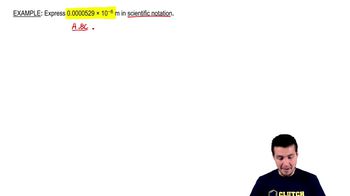
Rewriting in Scientific Notation
151
views
Guided course
03:18
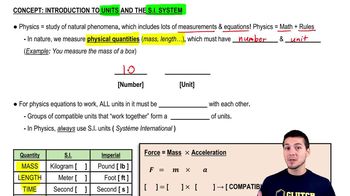
Introduction to Units & the SI System
872
views
13
rank
3
comments
Terms in this set (26)
Hide definitions
What must physical quantities have in measurements?
Physical quantities must have
magnitude
and
units
.
Why must all units in physics equations be compatible?
Units must be compatible to ensure equations work correctly; compatible units form a
system of units
.
What is the standard system of units used in physics?
The
Système International (S.I.)
system is the standard system of units used in physics.
What is a metric prefix?
A metric prefix is a letter or symbol placed before a base unit to represent a specific power of 10 multiplied by the base unit.
How does the number change when shifting from a bigger to a smaller metric unit?
The number becomes
larger
when shifting from a bigger to a smaller unit.
How does the number change when shifting from a smaller to a bigger metric unit?
The number becomes
smaller
when shifting from a smaller to a bigger unit.
What is scientific notation used for?
Scientific notation is used to convert very long or inconvenient numbers into shorter, more manageable forms.
How do you convert a standard number to scientific notation?
Move the decimal to get a number ≥ 1 but < 10, round to 2 decimal places, and use the number of decimal places moved as the exponent.
What is the first step in unit conversions?
Write the given and target units clearly.
How do you handle unit conversions with exponents?
Multiply the conversion factor as many times as the exponent indicates.
What is dimensional analysis?
Dimensional analysis checks if the units on both sides of an equation are consistent, ensuring the equation makes sense.
What are significant figures?
Significant figures are the number of digits in a measurement that carry meaningful information about its precision.
How do you count significant figures in a number with no decimal point?
Eliminate leading zeros and trailing zeros, then count the remaining digits.
What is the rule for significant figures in addition and subtraction?
Round the answer to the same number of decimal places as the number with the least decimal places.
What is the rule for significant figures in multiplication and division?
Round the answer to the same number of significant figures as the number with the least significant figures.
What is the difference between vectors and scalars?
Vectors have both
magnitude and direction
, while scalars have only
magnitude
.
What is displacement compared to distance?
Displacement is a vector showing change in position with direction, while distance is a scalar showing total length traveled.
How are vectors graphically added?
Vectors are added tip-to-tail, and the resultant vector is the shortest path from the start of the first to the end of the last vector.
How do you subtract vectors graphically?
Subtracting vectors is like adding, but one vector is reversed in direction before adding tip-to-tail.
What happens when you multiply a vector by a scalar?
The vector's magnitude changes by the scalar, but its direction remains the same.
How do you decompose a vector into components?
Use trigonometry: 𝑨𝒙 = 𝑨 cos(𝜽𝒙) and 𝑨𝒚 = 𝑨 sin(𝜽𝒙), where 𝜽𝒙 is the angle with the x-axis.
How do you find the magnitude and direction of a vector from components?
Magnitude: 𝑨 = √(𝑨𝒙² + 𝑨𝒚²); Direction: 𝜽𝒙 = tan⁻¹(𝑨𝒚 / 𝑨𝒙).
What are unit vectors and their directions?
Unit vectors have magnitude 1 and point in coordinate directions: 𝒊̂ (x), 𝒋̂ (y), 𝒌̂ (z).
How do you add vectors using unit vector notation?
Add corresponding components: 𝑹⃗ = (𝑨𝒙 + 𝑩𝒙)𝒊̂ + (𝑨𝒚 + 𝑩𝒚)𝒋̂.
How do you handle vector directions in different quadrants?
Use reference angles and adjust signs of components based on quadrant to find absolute direction.
How are directions described using compass angles?
Angles are given as degrees north/south of east/west, with the arrow drawn towards the second direction.
 BackBack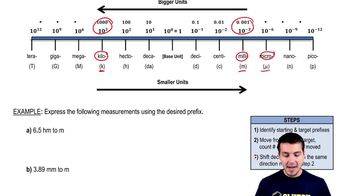
 06:06
06:06