Back

Types of Motion & Energy quiz

Control buttons has been changed to "navigation" mode.
1/15
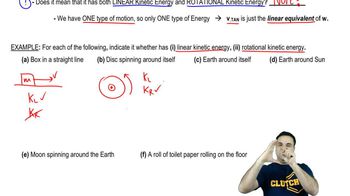
  • What type of kinetic energy does a box moving in a straight line possess?

    A box moving in a straight line possesses only linear kinetic energy.
  • What type of kinetic energy does a disk spinning around its axis have?

    A disk spinning around its axis has only rotational kinetic energy.
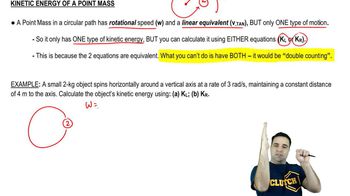
  • When an object moves in a circular path, which kinetic energy formula can be used to calculate its energy?

    You can use either the linear kinetic energy formula (Kl = 0.5 * m * v^2) or the rotational kinetic energy formula (Kr = 0.5 * I * omega^2); both are mathematically equivalent.
  • Why should you not add linear and rotational kinetic energies for a point mass in circular motion?

    Because both formulas describe the same physical motion and adding them would double-count the energy.
  • What is the relationship between tangential velocity and angular speed in circular motion?

    Tangential velocity (v) is related to angular speed (omega) by the equation v = r * omega.
  • What type of kinetic energy does the Earth have as it spins around its own axis?

    The Earth has rotational kinetic energy as it spins around its own axis.
  • What type of kinetic energy does the Earth have as it orbits the Sun?

    The Earth has rotational kinetic energy as it orbits the Sun, since its center of mass moves in a circle.
  • How many types of kinetic energy does a roll of toilet paper have when rolling across the floor?

    A roll of toilet paper has both linear and rotational kinetic energy when rolling across the floor.
  • What type of kinetic energy does the moon have as it orbits the Earth?

    The moon has only rotational kinetic energy as it orbits the Earth, because it is tidally locked and does not spin independently.
  • What is the moment of inertia for a point mass at a distance r from the axis?

    The moment of inertia (I) for a point mass is I = m * r^2.
  • What is the convention for calculating kinetic energy for an object moving in a circle?

    The convention is to treat the motion as rotational kinetic energy and not linear, to avoid double-counting.
  • What happens mathematically when you substitute v = r * omega into the linear kinetic energy formula for a point mass?

    The formula simplifies to the rotational kinetic energy formula, showing they are equivalent for circular motion.
  • In rolling motion, why does an object have both linear and rotational kinetic energy?

    Because the object moves sideways (translational motion) and spins around its own axis (rotational motion).
  • What is the total kinetic energy of the Earth considering both its rotation and its orbit around the Sun?

    The total kinetic energy is the sum of two rotational kinetic energies: one for spinning around itself and one for orbiting the Sun.
  • Why is it important to avoid double-counting kinetic energy in problems involving circular motion?

    Double-counting leads to incorrect results because linear and rotational formulas describe the same energy for circular motion.