Back

Types of Acceleration in Rotation quiz

Control buttons has been changed to "navigation" mode.
1/15
  • What are the four types of acceleration in rotation problems?

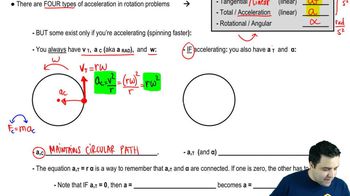
    Centripetal (a_c or a_rad), tangential (a_t or linear), total acceleration (a), and rotational/angular acceleration (alpha).
  • What is another name for centripetal acceleration?

    Centripetal acceleration is also called radial acceleration (a_rad).
  • What is the role of centripetal acceleration in circular motion?

    Centripetal acceleration maintains the circular path of an object, keeping it moving in a circle.
  • When do tangential acceleration (a_t) and angular acceleration (alpha) exist?

    They exist when an object is speeding up or slowing down in its rotational motion; they are zero if the rotational speed is constant.
  • How is total acceleration (a) calculated in rotational motion?

    Total acceleration is the vector sum of tangential and centripetal accelerations: a = sqrt(a_t^2 + a_c^2).
  • What are the units for linear and angular accelerations?

    Linear accelerations (a_c, a_t, a) are measured in meters per second squared (m/s^2), while angular acceleration (alpha) is in radians per second squared (rad/s^2).
  • What equation links tangential acceleration (a_t) and angular acceleration (alpha)?

    The equation a_t = r * alpha links tangential and angular acceleration.
  • If an object moves at constant rotational speed, what are the values of a_t and alpha?

    Both a_t and alpha are zero when rotational speed is constant.
  • How can centripetal acceleration (a_c) be expressed in terms of angular velocity (omega)?

    Centripetal acceleration can be written as a_c = r * omega^2.
  • What happens to total acceleration (a) if tangential acceleration (a_t) is zero?

    Total acceleration simplifies to a = a_c if a_t is zero.
  • What does tangential acceleration (a_t) physically represent in rotation?

    Tangential acceleration represents the rate of change of the object's tangential (linear) speed along the circular path.
  • What is the formula for tangential velocity (v_t) in terms of radius and angular velocity?

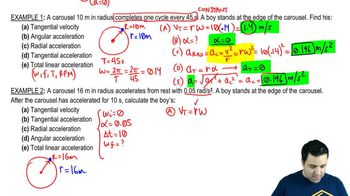
    Tangential velocity is given by v_t = r * omega.
  • In the carousel example, why is angular acceleration (alpha) zero?

    Alpha is zero because the carousel rotates at a constant speed, so there is no change in angular velocity.
  • What is the relationship between centripetal force and centripetal acceleration?

    Centripetal acceleration exists because a centripetal force pulls the object toward the center of the circle.
  • If only centripetal acceleration is present, what does this indicate about the object's motion?

    It indicates the object is moving in a circle at constant speed, with no change in rotational speed.