What is the main difference between vertical and horizontal mass-spring systems?
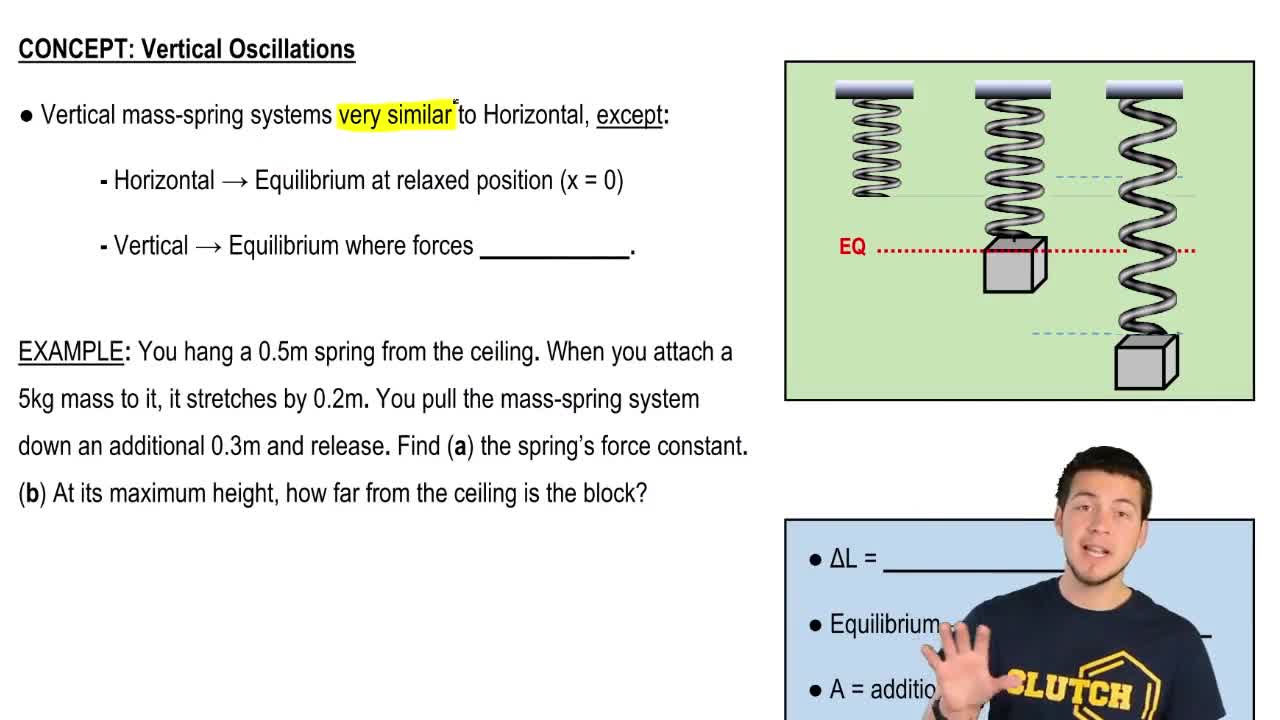
The main difference is that in vertical systems, gravity acts on the mass, so equilibrium is where the spring's restoring force balances the gravitational force.
What does the equilibrium extension \(\Delta L\) represent in a vertical spring system?
\(\Delta L\) is the additional length the spring stretches due to the attached mass, reaching a new equilibrium position.
How is the equilibrium condition for a vertical spring system mathematically expressed?
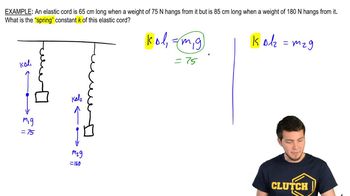
The equilibrium condition is \(K \Delta L = mg\), where K is the spring constant, \(\Delta L\) is the extension, m is mass, and g is gravitational acceleration.
If a 5 kg mass stretches a spring by 0.2 m under gravity (g = 10 m/s²), what is the spring constant K?
The spring constant K is 250 N/m, calculated using \(K = mg/\Delta L = 5 \times 10 / 0.2\).
What is the amplitude in a vertical spring oscillation?
The amplitude is the additional distance the spring is pulled or pushed from its equilibrium position, not the equilibrium extension.
How do you distinguish between \(\Delta L\) and amplitude in a vertical spring problem?
\(\Delta L\) is the equilibrium stretch due to the mass, while amplitude is any extra displacement from equilibrium for oscillation.
What is the original length of the spring in the example provided?
The original length of the spring is 0.5 meters.
After attaching the mass, what is the total length of the spring at equilibrium?
The total length at equilibrium is 0.7 meters (original length plus equilibrium extension: 0.5 + 0.2).
If the spring is pulled an additional 0.3 m downward from equilibrium, what is the maximum stretched length?
The maximum stretched length is 1.0 meter (0.7 m equilibrium length plus 0.3 m amplitude).
How do you calculate the minimum distance from the ceiling to the block during oscillation?
Subtract the amplitude from the equilibrium length: 0.7 m - 0.3 m = 0.4 m.
What forces act on the mass at the new equilibrium position in a vertical spring system?
The upward spring force (K\(\Delta L\)) and the downward gravitational force (mg) act and balance each other.
Why does the spring stop stretching after a certain point when a mass is attached?
It stops stretching when the upward restoring force equals the downward gravitational force, reaching equilibrium.
What happens to the mass after it is pulled down and released from the equilibrium position?
The mass oscillates up and down around the equilibrium position with the amplitude equal to the extra displacement.
In the context of vertical springs, what does the term 'restoring force' refer to?
The restoring force is the upward force exerted by the spring, proportional to its extension from equilibrium.
What is the maximum distance from the ceiling to the block during oscillation in the example?
The maximum distance is 1.0 meter, which is the equilibrium length plus the amplitude (0.7 + 0.3).
 Back
Back

 04:52
04:52