Back

Internal Energy of Gases quiz

Control buttons has been changed to "navigation" mode.
1/15
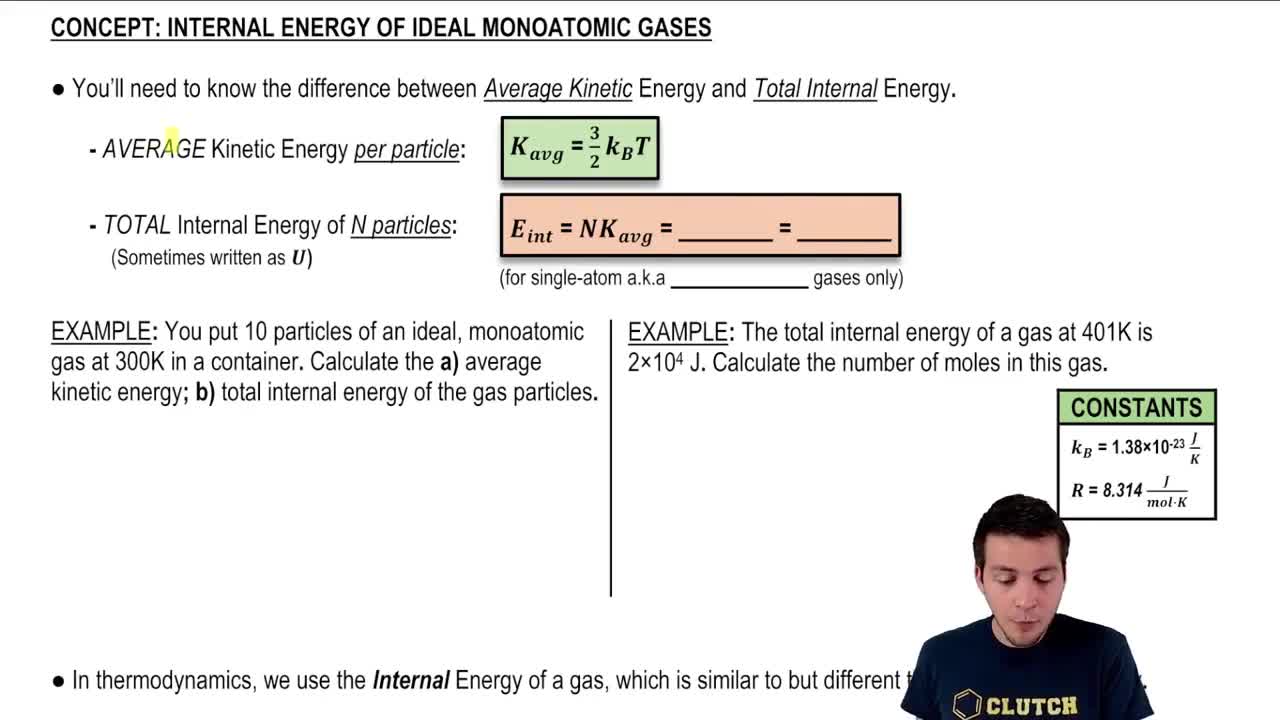
  • What is the formula for the average kinetic energy per particle in an ideal gas?

    The formula is (3/2)kBT, where kB is the Boltzmann constant and T is the temperature in Kelvin.
  • How do you calculate the total internal energy for a collection of gas particles?

    Multiply the average kinetic energy per particle by the number of particles: E_internal = N × (3/2)kBT.
  • What symbol is commonly used to represent total internal energy in this lesson?

    The symbol E_internal is used to represent total internal energy.
  • How can the total internal energy be expressed in terms of moles and the ideal gas constant?

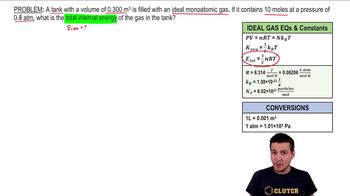
    E_internal = (3/2)nRT, where n is the number of moles, R is the ideal gas constant, and T is the temperature.
  • For which type of gas is the equation E_internal = (3/2)nRT valid?

    This equation is valid only for monoatomic gases.
  • What is the main difference between average kinetic energy and total internal energy?

    Average kinetic energy is per particle, while total internal energy is for all particles in the system.
  • If you have 10 particles each with an average kinetic energy of 6.21 × 10⁻²¹ J, what is the total internal energy?

    The total internal energy is 10 × 6.21 × 10⁻²¹ J = 62.1 × 10⁻²¹ J.
  • What is the relationship between n, kB, and R in the context of the ideal gas law?

    n × kB is equivalent to n × R, where n is the number of moles.
  • What is the difference between macroscopic mechanical energy and microscopic internal energy?

    Mechanical energy concerns the kinetic and potential energy of the whole object, while internal energy focuses on the energies of the particles inside the object.
  • What does macroscopic mean in the context of energy?

    Macroscopic refers to large-scale properties, such as the energy of the entire object.
  • What does microscopic mean in the context of internal energy?

    Microscopic refers to small-scale properties, specifically the energies of individual particles within an object.
  • When calculating total internal energy, which equation should you use if you are given the number of moles?

    Use E_internal = (3/2)nRT when the number of moles is given.
  • What is the ideal gas constant R approximately equal to?

    R is approximately 8.314 J/(mol·K).
  • If the total internal energy of a monoatomic gas is 2 × 10⁴ J at 401 K, how many moles are present?

    There are 4 moles present, calculated using E_internal = (3/2)nRT.
  • Why is total internal energy often used in thermodynamics instead of average kinetic energy?

    Total internal energy is easier to measure and more relevant for large-scale systems in thermodynamics.