Back

Heat Engines & PV Diagrams quiz

Control buttons has been changed to "navigation" mode.
1/15
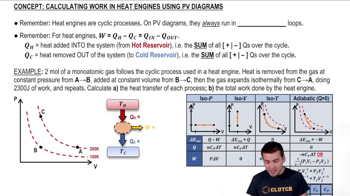
  • What does a cyclic process mean in the context of a heat engine?

    A cyclic process means the system returns to its initial state at the end of each cycle, starting and ending at the same point.
  • On a PV diagram, in which direction do heat engine cycles typically run?

    Heat engine cycles typically run in a clockwise direction on a PV diagram.
  • What equation is used to calculate heat transfer during an isobaric process?

    The equation used is Q = nCpΔT, where Cp is the molar specific heat at constant pressure.
  • What is the value of Cp for a monoatomic gas?

    For a monoatomic gas, Cp = 5/2 R, where R is the gas constant.
  • How do you calculate heat transfer during an isochoric (isovolumetric) process?

    Use Q = nCvΔT, where Cv is the molar specific heat at constant volume.
  • What is the value of Cv for a monoatomic gas?

    For a monoatomic gas, Cv = 3/2 R.
  • What is the relationship between heat transfer and work in an isothermal process?

    In an isothermal process, the heat transfer Q equals the work done W (Q = W).
  • How is the total work done by a heat engine represented on a PV diagram?

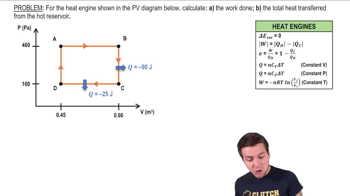
    The total work done is the area enclosed within the loop of the PV diagram.
  • Why can't the area inside the PV diagram loop always be calculated directly?

    It can't always be calculated directly if specific values for pressure and volume are not given or if the process involves curves like isotherms.
  • What alternative method is used to calculate the work done by a heat engine if the PV area can't be found?

    The work done is calculated as the difference between the heat added to the system (Qh) and the heat removed (Qc): W = Qh - Qc.
  • How do you determine Qh and Qc from the heat transfers in each process?

    Qh is the sum of all positive Q values (heat added), and Qc is the sum of the absolute values of all negative Q values (heat removed).
  • What is the importance of sign conventions when calculating work using Qh and Qc?

    It's important to use the absolute values for Qc to avoid errors, as negative Q indicates heat removed from the system.
  • What is the calculated total work done by the engine in the example problem?

    The total work done by the engine is 637 Joules.
  • What are the calculated heat transfers for the isobaric, isochoric, and isothermal processes in the example?

    Isobaric: -4157 J, Isochoric: 2494 J, Isothermal: 23100 J.
  • Why is it necessary to sum all positive and negative Q values when using the energy flow diagram method?

    Because heat can be added or removed in multiple steps, so all positive Q values contribute to Qh and all negative Q values to Qc.