Back

Gravitational Potential Energy for Systems of Masses quiz

Control buttons has been changed to "navigation" mode.
1/15
  • What is gravitational potential energy between two masses called in a system of multiple masses?

    It is denoted as 'u' with subscripts indicating the masses involved, such as u12 for mass 1 and mass 2.
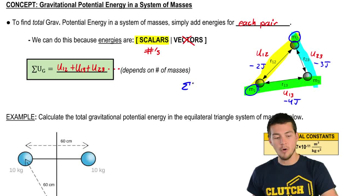
  • How do you calculate the total gravitational potential energy in a system of three masses?

    You add the gravitational potential energies of all pairs of masses: u12, u13, and u23.
  • Why can gravitational potential energies be added directly without considering direction?

    Because energies are scalars, not vectors, so you simply add their values without worrying about direction.
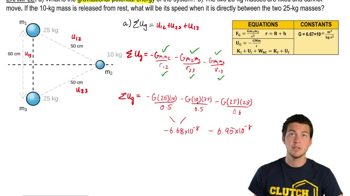
  • What is the formula for gravitational potential energy between two masses?

    The formula is U = -G * m1 * m2 / r, where G is the gravitational constant, m1 and m2 are the masses, and r is the distance between them.
  • Why are gravitational potential energies negative?

    They are negative because gravitational attraction is always pulling masses together, lowering their energy relative to infinity.
  • In an equilateral triangle of masses, what simplifies the calculation of potential energy?

    All distances between the masses are equal, so you use the same value for r in each pair's calculation.
  • What is the value of the gravitational constant G used in these calculations?

    G is 6.67 x 10^-11 N·m²/kg².
  • How do you label the masses in a system to keep track of calculations?

    You assign labels such as m1, m2, and m3 to each mass.
  • What is the total gravitational potential energy for the example with three masses in an equilateral triangle?

    It is calculated to be -5.55 x 10^-8 joules.
  • What does the sigma symbol (Σ) represent in the context of gravitational potential energy?

    It represents the sum of all gravitational potential energies between pairs of masses in the system.
  • If the potential energies between pairs are -2, -3, and -4 joules, what is the total gravitational potential energy?

    The total is simply the sum: -2 + (-3) + (-4) = -9 joules.
  • What is the distance used in the example for the equilateral triangle of masses?

    The distance between each pair of masses is 60 centimeters, or 0.6 meters.
  • How many pairs of masses are there in a system of three masses?

    There are three pairs: (m1, m2), (m1, m3), and (m2, m3).
  • Why is it unnecessary to use trigonometry when adding gravitational potential energies?

    Because potential energies are scalars, you do not need to consider angles or vector components.
  • What is a recommended way to practice calculating gravitational potential energy for systems of masses?

    Work through examples with different numbers of masses and distances to gain familiarity with the calculations.