Physics
My Course
Learn
Exam Prep
AI Tutor
Study Guides
Textbook Solutions
Flashcards
Explore
Try the app
My Course
Learn
Exam Prep
AI Tutor
Study Guides
Textbook Solutions
Flashcards
Explore
Try the app
Back
Energy of Rolling Motion quiz
You can tap to flip the card.
What two types of kinetic energy does an object in rolling motion possess?
You can tap to flip the card.
👆
What two types of kinetic energy does an object in rolling motion possess?
An object in rolling motion has both linear kinetic energy and rotational kinetic energy.
Track progress
Control buttons has been changed to "navigation" mode.
1/15
Related flashcards
Related practice
Recommended videos
Energy of Rolling Motion definitions
Energy of Rolling Motion
15 Terms
Energy of Rolling Motion
13. Rotational Inertia & Energy
2 problems
Topic

Patrick
13. Rotational Inertia & Energy - Part 1 of 2
5 topics
11 problems
Chapter

David-Paige
13. Rotational Inertia & Energy - Part 2 of 2
6 topics
10 problems
Chapter
David-Paige
Guided course
06:15
Energy of Rolling Motion (Surface vs Air)
3
views
Guided course
05:32
Ratio of energies of cylinder on surface
2
views
Terms in this set (15)
Hide definitions
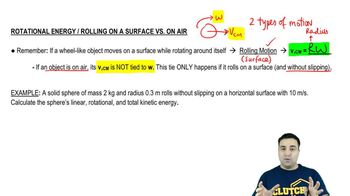
What two types of kinetic energy does an object in rolling motion possess?
An object in rolling motion has both linear kinetic energy and rotational kinetic energy.
What is the equation relating linear velocity (V_CM) and angular velocity (omega) for rolling without slipping?
The equation is V_CM = R * omega, where R is the radius of the object.
When does the equation V_CM = R * omega apply to a rolling object?
It applies only when the object is rolling on a surface without slipping.
Does the equation V_CM = R * omega apply to an object spinning through the air?
No, it does not apply if the object is rolling through the air.
What is the formula for the moment of inertia (I) of a solid sphere?
The moment of inertia for a solid sphere is I = (2/5) * m * R^2.
How do you calculate the linear kinetic energy of a rolling object?
Linear kinetic energy is calculated using (1/2) * m * V^2, where m is mass and V is velocity.
How do you find angular velocity (omega) if you know V_CM and R?
Angular velocity omega is found by omega = V_CM / R.
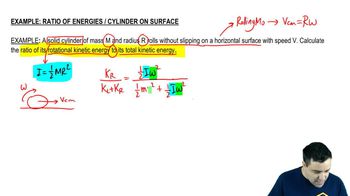
What is the formula for rotational kinetic energy?
Rotational kinetic energy is (1/2) * I * omega^2.
How do you calculate the total kinetic energy of a rolling object?
Total kinetic energy is the sum of linear and rotational kinetic energies.
In the example, what is the linear kinetic energy of the sphere if mass is 2 kg and V_CM is 10 m/s?
The linear kinetic energy is 100 Joules.
In the example, what is the rotational kinetic energy of the sphere?
The rotational kinetic energy is 40 Joules.
What is the total kinetic energy of the rolling sphere in the example?
The total kinetic energy is 140 Joules.
Why can you use the equation V_CM = R * omega in the example problem?
Because the sphere is rolling without slipping on a surface.
What does 'rolling without slipping' mean in the context of rolling motion?
It means the object rolls on the surface such that its point of contact does not slide.
Are the linear and rotational kinetic energies of a rolling object always equal?
No, they are not necessarily the same; their values depend on the object's mass, velocity, and moment of inertia.