Back

Conservation of Energy with Rotation quiz

Control buttons has been changed to "navigation" mode.
1/15
  • What is the main difference when applying conservation of energy to rotational problems compared to linear problems?

    In rotational problems, kinetic energy includes both linear and rotational components, whereas in linear problems, it is only linear kinetic energy.
  • What is the general form of the conservation of energy equation used in rotational dynamics?

    The equation is K_initial + U_initial + Work_non_conservative = K_final + U_final.
  • What does 'work non-conservative' include in the energy equation?

    It includes work done by external forces (like you pulling) and work done by friction.
  • How do you simplify calculations when both linear velocity (v) and angular velocity (ω) appear in a rotational energy problem?

    You rewrite one variable in terms of the other, usually using the relationship v = rω, to reduce the number of variables.
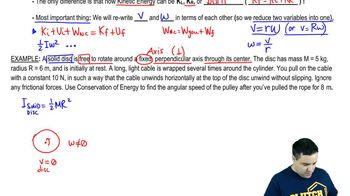
  • What is the moment of inertia for a solid disc rotating about its center?

    The moment of inertia is I = (1/2) M R^2, where M is mass and R is radius.
  • In the example, why is the initial kinetic energy zero?

    Because the disc starts at rest, so both its linear and rotational kinetic energies are zero.
  • Why can you use the equation v_rope = r * ω_disc when the cable unwinds without slipping?

    Because 'without slipping' means the linear speed of the rope matches the tangential speed at the disc's edge.
  • What does the variable 'r' represent in the equation v = rω?

    It represents the distance from the axis of rotation to the point where the force (or rope) is applied, which is often but not always the radius.
  • Why is potential energy ignored in the example problem?

    Because the height of the disc does not change, so the change in potential energy is zero.
  • How do you calculate the work done by pulling the rope in the example?

    Work is calculated as force times distance times cosine of the angle between them: W = Fd cos(θ), which is 10 N × 8 m × 1 = 80 J.
  • What type of kinetic energy does the disc have at the end of the example problem?

    It has only rotational kinetic energy, since it spins about a fixed axis and does not translate.
  • How is the final angular velocity (ω_final) of the disc found using conservation of energy?

    By setting the work done equal to the final rotational kinetic energy and solving for ω_final.
  • What is the final angular velocity of the disc after pulling the rope for 8 meters with a 10 N force?

    The final angular velocity is 1.33 radians per second.
  • Why is friction ignored in the example problem?

    Because the problem states to ignore frictional forces, or if not stated, it is assumed negligible unless specified.
  • When should you convert between v and ω in rotational energy problems?

    You should convert when both variables appear in your equations, to reduce the problem to a single variable for easier solving.