Back

Conservation of Energy in Rolling Motion quiz

Control buttons has been changed to "navigation" mode.
1/15
  • What two types of motion are involved in rolling motion?

    Rolling motion involves both rotation around an axis and translation along a surface.
  • What is the role of static friction in rolling motion?

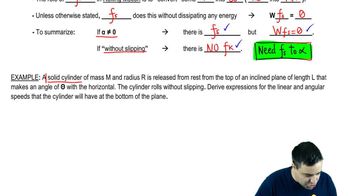
    Static friction enables rolling by converting some linear velocity into angular velocity without dissipating energy.
  • Does static friction do any work in rolling motion without slipping?

    No, the work done by static friction is zero in rolling motion without slipping.
  • What does 'rolling without slipping' imply about the types of friction present?

    It means static friction is present but kinetic friction is absent.
  • What is the relationship between linear velocity (v) and angular velocity (omega) in rolling motion?

    The relationship is v = r * omega, where r is the radius of the object.
  • What is the moment of inertia (I) for a solid cylinder?

    For a solid cylinder, I = (1/2) M R^2, where M is mass and R is radius.
  • How is conservation of energy applied in rolling motion problems?

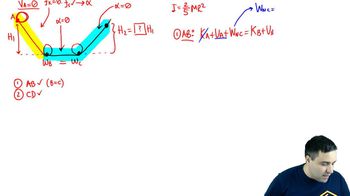
    Both translational and rotational kinetic energies, as well as potential energy, are considered, with total mechanical energy conserved.
  • What types of kinetic energy does a rolling object have at the bottom of an incline?

    It has both translational kinetic energy (1/2 mv^2) and rotational kinetic energy (1/2 I omega^2).
  • How do you express omega in terms of v for a rolling object?

    Omega can be written as v/r, where v is linear velocity and r is radius.
  • Why do the masses and radii often cancel out in rolling motion energy equations?

    Because all terms involve the same object, allowing m and r to be factored out and canceled.
  • What is the final velocity formula for a solid cylinder rolling down an incline of length l and angle theta?

    v_final = sqrt[(4 g l sin(theta))/3], where g is gravity.
  • How does the final velocity of a rolling object compare to that of a sliding block?

    The rolling object's final velocity is lower due to energy being shared between translational and rotational forms.
  • What is the typical coefficient in the velocity formula for a rolling solid cylinder compared to a sliding block?

    For a rolling solid cylinder, the coefficient is 4/3, which is less than the coefficient 2 for a sliding block.
  • Why is the coefficient in the rolling motion velocity formula always less than in linear motion?

    Because some energy is used for rotation, leaving less for translational motion, resulting in a lower velocity.
  • What should you check if your calculated coefficient in a rolling motion problem is greater than the linear case?

    You should check your work, as the coefficient for rolling should always be less than that for linear motion.